
The AI Double Bind: Mandated to Use It, Watermarked When You Do, Accused When You Don't
Companies now require AI use, vendors are watermarking every output, and good writers are being told they sound like a machine. A deep look at how AI systems are built, where the data risk really sits, why restrictive policies create the exposure they fear, why returns flatten, what watermarks and detectors can and cannot prove, and what acceptable use will look like by 2030.
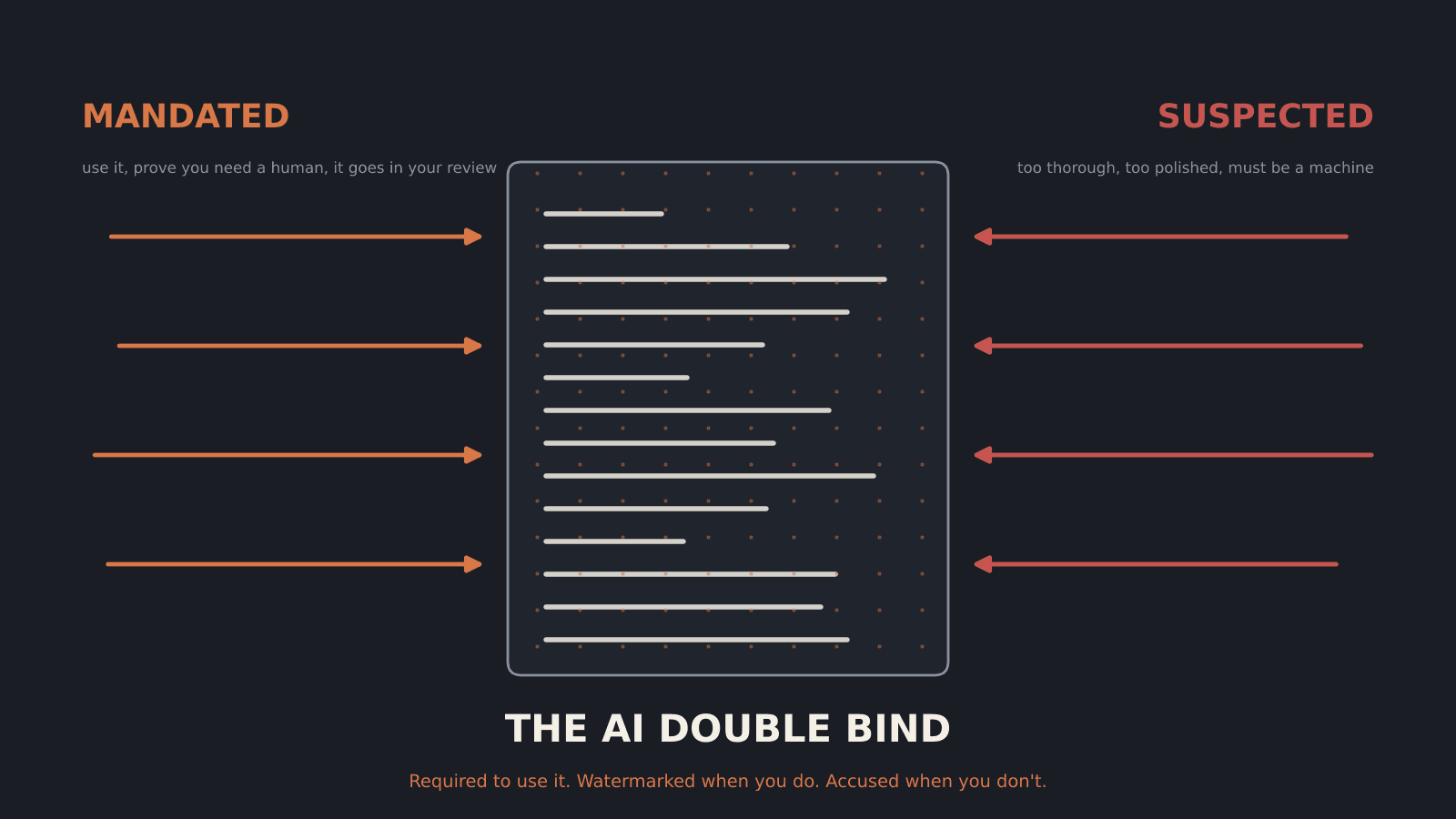
Somewhere in the last eighteen months, I have heard of knowledge workers who received three messages, regarding AI content, that cannot all be true at once. The first came from leadership: AI is now a baseline expectation, learn it or explain why you need a human. The second came from a vendor: starting this month, everything the model writes carries an invisible mark that regulators and employers can test for. The third came from organization leadership, usually with a wince: people are starting to say you use AI too much.
That is the double bind. You are required to use the tool. The tool is now stamped so that using it can be proven. And the people around you have decided that anything thorough, well-structured, or free of typos is evidence of the tool, whether you touched it or not.
I have spent many years in product delivery, program management, and transformation work, and I have never seen an operating model contradict itself this openly. I want to take the whole thing apart in this post, and then say what I think acceptable use looks like by 2030, because somebody has to write the policy and it should not be whoever is loudest in the Slack channel.
It is a long one, so here is the map. Jump to whatever you came for.
- Where AI actually lives now, personally and professionally: the adoption numbers, and the gap between use and sanction
- What an AI feature is actually made of: the five layers, and where your data touches each one
- Where the data goes, and why BAAs became the center of the conversation: the three doors a prompt can take, and the PHI rules
- When the policy is the vulnerability: how a ban removes the logs instead of the demand
- Assume the data is already exposed, then build for that: the AI surfaces you did not buy, the IBM breach numbers, and the mitigation ladder
- The drive to put AI in everything, and what the returns actually look like: mandates, MIT NANDA, METR, workslop
- The sudden corporate panic about using it too much: de-skilling and the whiplash
- Same tool, two verdicts: why AI in the codebase is a KPI and AI in a memo is a tell
- This week's watermarks, what they actually do, and how they leak: the mechanism, the rollout, the bypasses
- The accusation problem: detectors, when a Python script gets mistaken for a model, what they do to people, what MIT did instead, and the reporting chain
- What acceptable use will look like by 2030: eight predictions
- What I would actually put in the policy: the skeleton
- The thing nobody wants to say out loud
Where AI actually lives now, personally and professionally
Start with the numbers, because the mandates are chasing behavior that already happened. Microsoft and LinkedIn's 2024 Work Trend Index surveyed 31,000 people across 31 countries and found that 75 percent of knowledge workers were already using AI at work, and that 78 percent of those users were bringing their own tools rather than waiting for one to be issued. Only 39 percent had received any training from their employer. Two years later the picture is more extreme, not less. Nightfall's 2026 analysis of more than 35,000 enterprise applications found 98 percent of organizations using generative AI, 49 percent running AI agents, and 81 percent of that usage happening outside the three providers the security team is actually watching.
The MIT NANDA group's report on the GenAI divide put the same gap in sharper terms. Only 40 percent of companies had purchased an official LLM subscription, but workers at more than 90 percent of companies reported regular use of personal AI tools for work. The official program is the minority case. The personal ChatGPT or Claude account on a phone, fed from a work laptop, is the majority case.
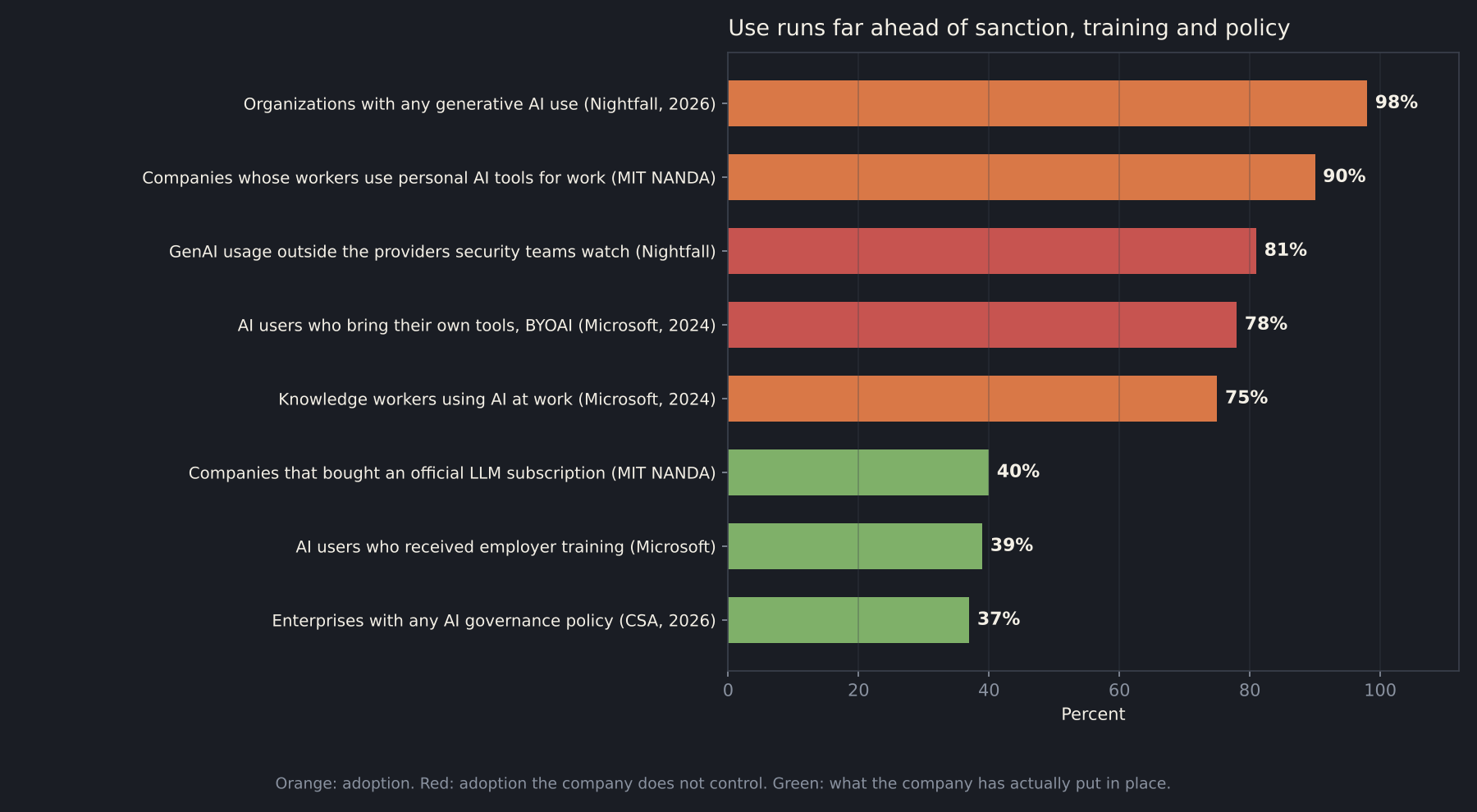
Put those figures on one chart and the shape is a cliff. Everything that measures use sits above 75 percent. Everything that measures what the company did about it sits below 40 percent. The Cloud Security Alliance's 2026 research note on shadow AI found only 37 percent of enterprises had any AI governance policy at all, and cited Gallup data that about 45 percent of workers using AI do not tell their managers. The gap between those two tiers of bars is where every risk in this post lives. It is also where every accusation in this post gets manufactured, because an organization that does not know who is using what has no choice but to guess.
The personal side matters because it leaks into the professional side. The most common consumer uses are not spreadsheets. A Fortune piece on what the author called social offloading quoted Skillsoft's Leena Rinne describing the pattern as what happens "when interpersonal skills that require human judgement, empathy, or courage gets outsourced to AI," and quoted an employee saying, "I literally think my boss' AI is talking to my AI." I have watched that exact loop form on real teams. The performance review is drafted by a model, the response is drafted by a model, and two humans sign off on a conversation neither of them had.
So the baseline is this: nearly everyone uses it, most of them use it through a door the company does not control, few have been trained, and a growing share of the emotional labor of work is being routed through it too. Every policy decision downstream has to start from that reality rather than from the org chart.
What an AI feature is actually made of
Most acceptable-use policies I review describe AI as "the chatbot." That was roughly accurate in early 2023. It is not accurate now, and the gap between the mental model and the system is where the risk lives.
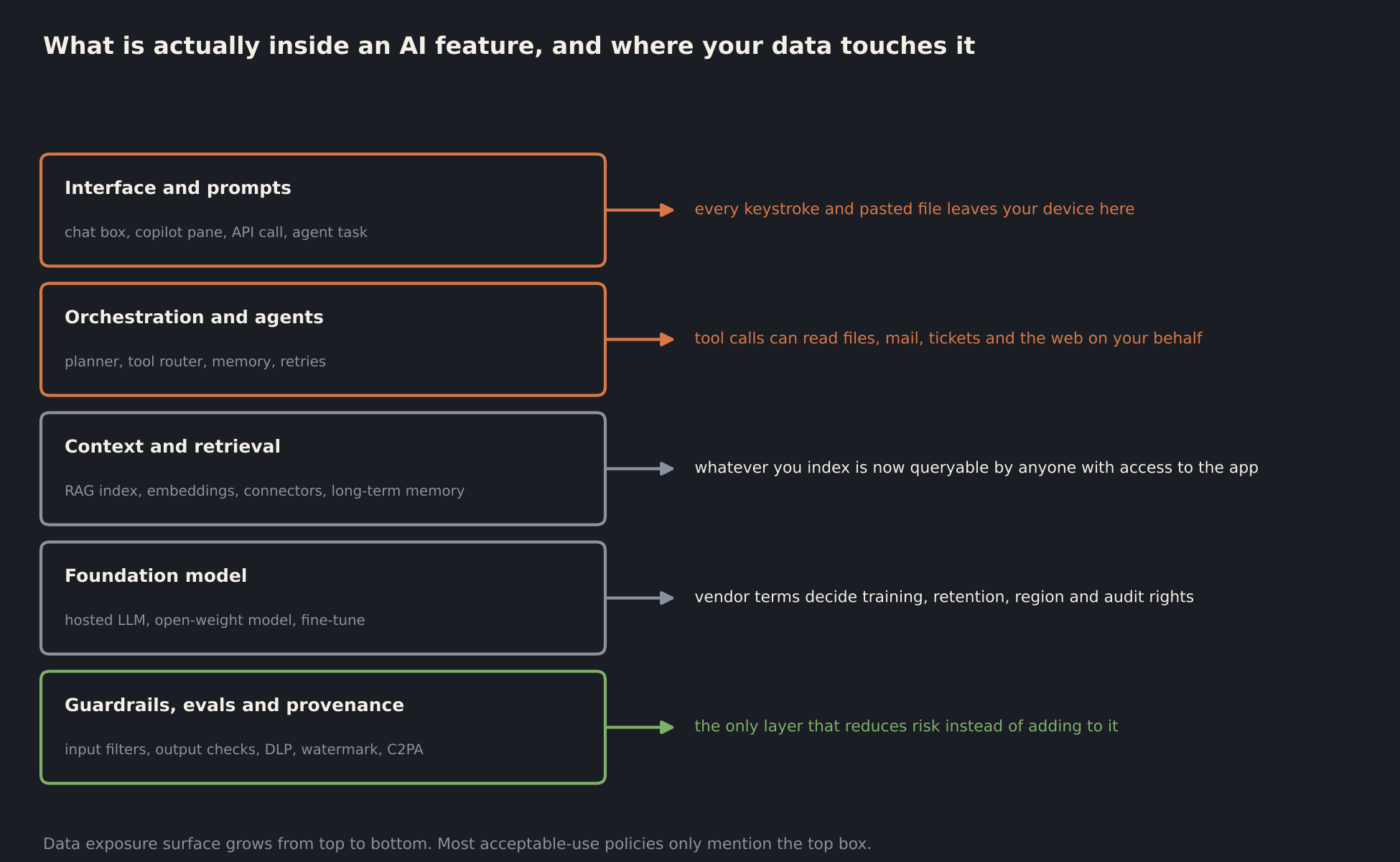
A production AI feature in 2026 has five layers, and your data touches every one of them.
The interface is the chat box, the copilot pane, the API call, or the task you hand an agent. Everything you type or paste leaves your device here. That part everyone understands.
Orchestration is the planner and router that turns a request into a sequence of model calls and tool calls. This is the layer that makes agentic systems different in kind. An agent with a connector to your mailbox, your file share, your ticketing system, and the open web can read all of those on your behalf, and it will if the task seems to call for it. The exposure is no longer what you pasted. It is what the agent decided it needed. I covered the governance side of this in The AI Agent Governance Gap, and the supply-chain side in Software Supply Chain Risk When Agents Choose Your Dependencies. The short version: an agent's permissions are your permissions, exercised without your judgment.
Context and retrieval is the index, the embeddings, the connectors, and increasingly the long-term memory that persists across sessions. Whatever you index becomes queryable by anyone who can reach the app. I have seen a shared drive indexed for a helpful internal assistant that then cheerfully surfaced a salary spreadsheet to an intern because nobody scoped the retrieval layer to the permissions of the person asking. The engineering discipline for this layer is what I called context engineering, and it is as much a security practice as a quality practice.
The foundation model is the hosted LLM, the open-weight model you run yourself, or a fine-tuned model. The vendor contract for this layer decides whether your prompts train the next model, how long they are retained, which region they sit in, and whether you have any audit rights. Most of the data policy questions people ask about "AI" are really questions about this contract.
Guardrails, evals, and provenance sit at the bottom: input filters, output checks, data loss prevention, the watermark, and content credentials. This is the only layer that reduces risk rather than adding to it, and it is the layer most teams build last or never. I wrote about why evals are the new acceptance criteria for any AI feature; the same evals are the first line of your data policy, because an unevaluated model is an unmeasured leak.
When a leader says "put AI in the product," they are usually picturing layer one. They are shipping all five. The policy, the security review, and the training have to cover all five too.
Where the data goes, and why BAAs became the center of the conversation
The first big corporate AI data story was Samsung in the spring of 2023, when engineers pasted proprietary source code and meeting notes into ChatGPT and the company banned generative AI tools company-wide within weeks. That was a consumer-app story. Three years later the pattern has not changed much. It has just scaled, and the consequences in regulated industries are heavier.
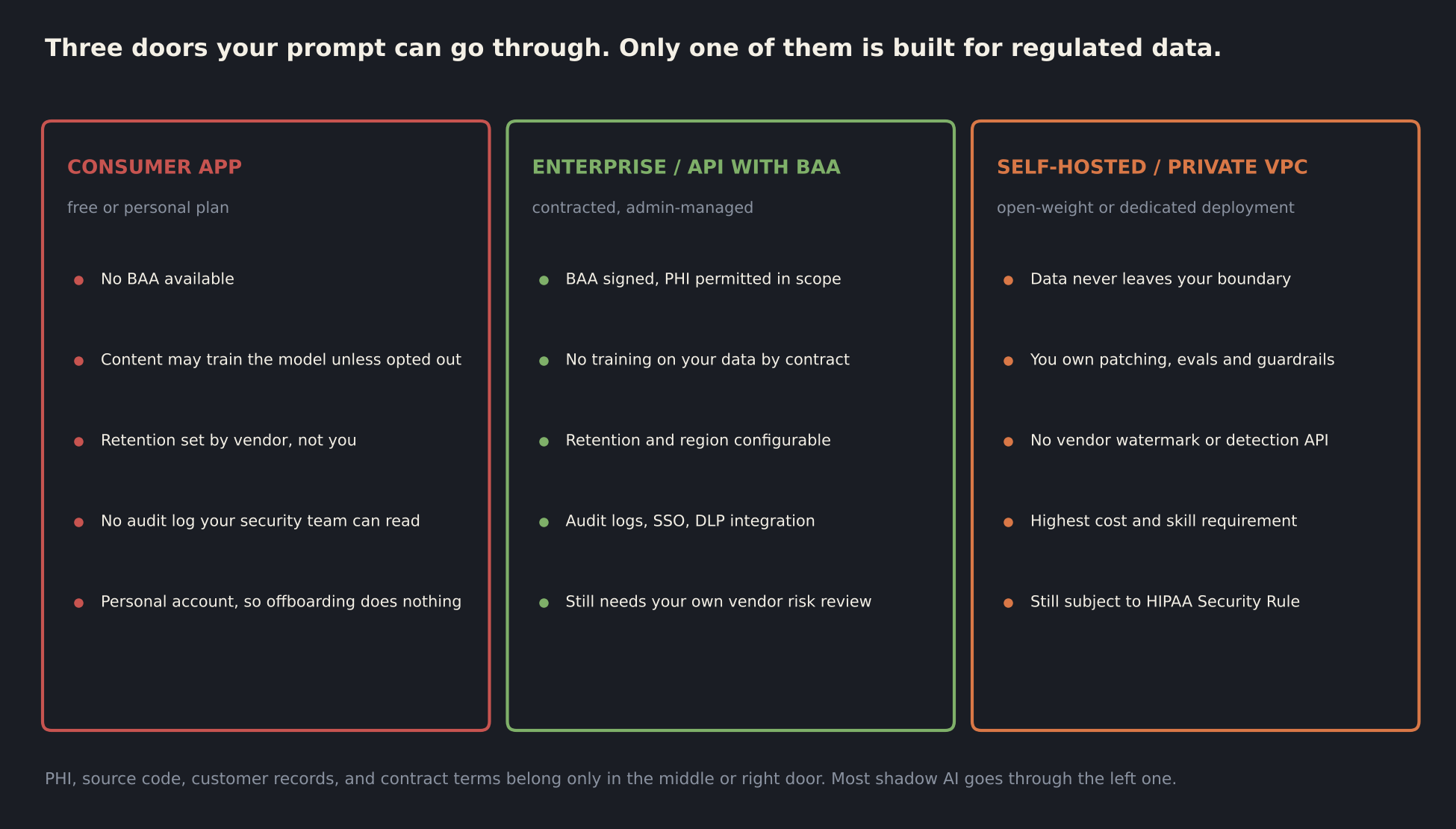
There are three doors a prompt can go through, and they are not interchangeable.
The consumer door is a free or personal plan. No business associate agreement is available. Content may be used to improve the model unless the user finds and flips the opt-out. Retention is set by the vendor. There is no audit log your security team can read, and because the account belongs to the person rather than the company, offboarding does nothing. This is the door most shadow AI goes through.
The enterprise or API door is a contracted, admin-managed plan. This is where a BAA can exist. A BAA, for anyone outside healthcare, is the HIPAA contract that makes a vendor a business associate: it sets permitted uses, breach notification duties, subcontractor flow-downs, and security obligations. Without one, you cannot lawfully hand protected health information to the vendor at all. As of this year the major labs do sign them for their enterprise and API products: OpenAI for the API and ChatGPT Enterprise, Anthropic for Claude via the API and commercial agreements, Google for Vertex AI, and Microsoft for Azure OpenAI under the existing Azure BAA. None of them cover the consumer apps, and none of them cover every feature by default. A signed BAA is necessary and not sufficient; you still owe your own vendor risk assessment, and you still have to configure retention and training opt-outs rather than assume them.
The self-hosted or private VPC door is an open-weight model or a dedicated deployment inside your boundary. Data never leaves. You also own patching, evals, guardrails, and the full HIPAA Security Rule. It is the highest-cost, highest-skill option, and for a lot of PHI workloads it is the right one.
Two technical points that get skipped in every policy I read. First, prompting a model to "remove identifiers" does not de-identify data. HIPAA's safe harbor method means stripping the eighteen specified identifiers; the expert determination method requires a documented statistical analysis. A model that was asked to anonymize a chart note and missed the patient's rare diagnosis plus their zip code has produced PHI that is now sitting in a vendor log. Second, the agent layer changes the BAA question. If your BAA covers the model API, but the agent reaches through a connector to a system that is not in scope, you have created a new business associate relationship nobody signed. Map the data flow across all five layers before signing anything.
The honest summary for a CISO: the risk is not that the model is malicious. It is that the easiest door is the wrong one, the employees have already walked through it, and the policy was written for a different building.
When the policy is the vulnerability
There is a failure mode on the other side of this that gets far less attention than shadow AI, and it produces shadow AI. It is the overly restrictive policy: the blanket ban, the single locked-down tool nobody wants, the six-month approval queue, the rule that is stricter than anything a peer company or a regulator actually asks for. I have reviewed policies that prohibit any AI assistance with internal documentation while the same company's vendors, auditors, and customers use it daily. That is not caution. It is a policy written to be defensible in a meeting rather than to be followed at a desk.
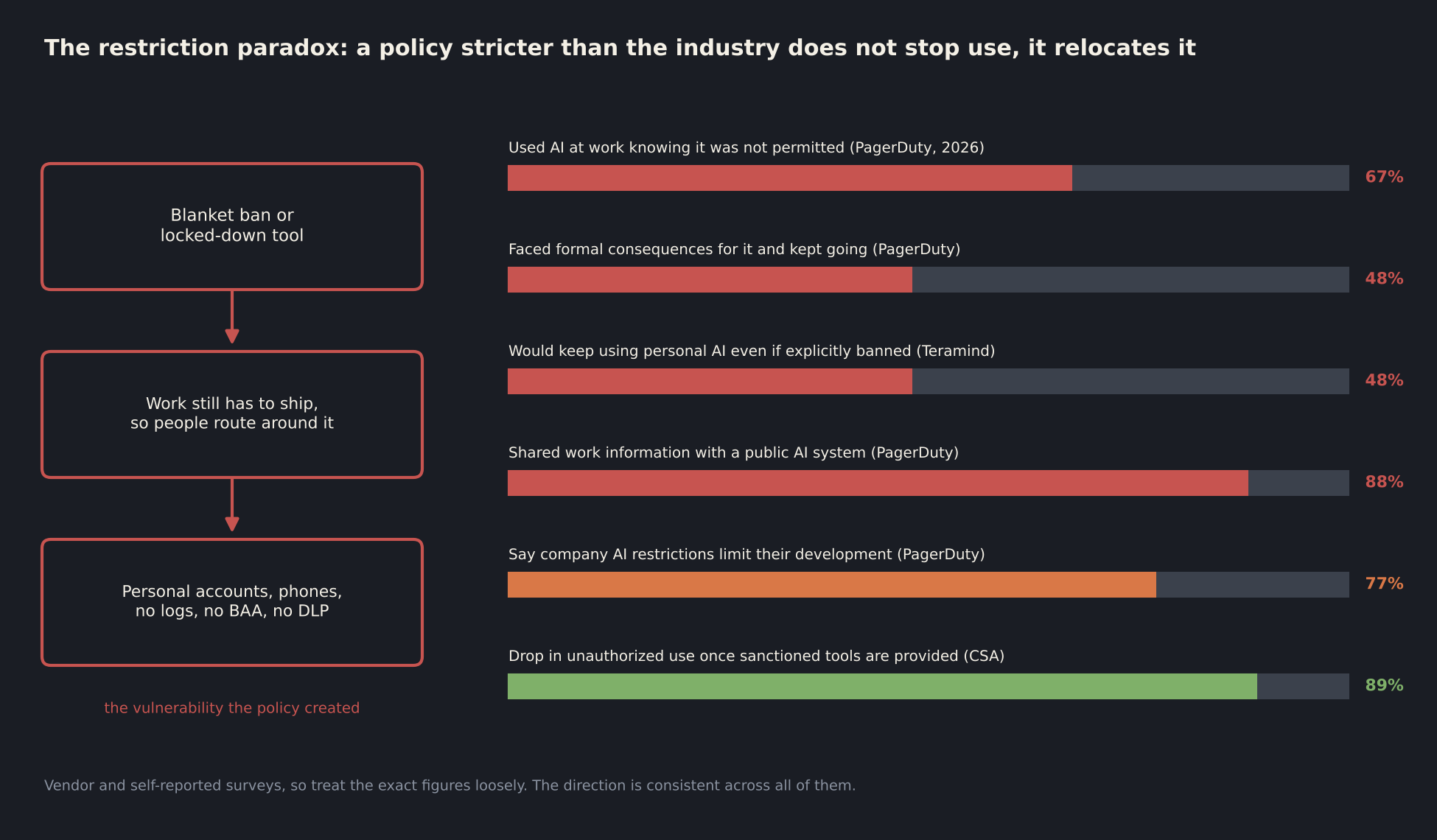
The data on what happens next is consistent even though most of it is vendor-sponsored and self-reported, so hold the exact numbers loosely and trust the direction. PagerDuty's 2026 survey found two in three office professionals had used AI at work knowing it was not permitted, that 48 percent had faced formal consequences and kept going, that 88 percent had shared work information with a public AI system, and that 77 percent felt company restrictions were limiting their professional development. Teramind's shadow AI report put the share who would keep using personal AI tools even under an explicit ban at nearly half, with 51 percent reporting conflicting guidance from their own employer. And the CSA note cites research finding that when organizations provision a sanctioned tool that people actually want, unauthorized use drops by 89 percent.
Read those together and the mechanism is plain. A ban does not remove the demand. It removes the logs. Work still has to ship, so people route around the restriction through the consumer door, which is the one door with no BAA, no retention control, no DLP, and no audit trail. The company has traded a risk it could see and manage for one it cannot see at all. In security terms, the restrictive policy did not reduce the attack surface; it moved the attack surface onto personal phones and home laptops, and then stopped measuring it.
The contradictions make it worse. When leadership mandates AI in the all-hands and the security team bans it in the handbook, employees do not resolve the conflict by asking. They resolve it by picking whichever instruction is cheaper to follow in the moment, which is always the personal account. When a policy says "approved tools only" and the approved tool cannot read a PDF or is three model generations behind what the employee uses at home, the policy has taught people that the sanctioned path is for show. And when the same organization then disciplines someone for sounding like a model, it has completed the loop: use it, hide it, get blamed for it anyway.
Congruence with the industry is not a nice-to-have here. It is the difference between a policy that people follow and a policy that generates workarounds. If your peers, your regulators, and your own vendors are operating on a risk-tiered model with a sanctioned enterprise tool, and you are operating on a ban, you have not made yourself safer than them. You have made yourself blind in a way they are not.
Assume the data is already exposed, then build for that
Here is the mental shift I push hardest with security and delivery leaders, because it dissolves most of the arguments about which tool to allow. In a modern stack, you no longer get to decide whether your data touches a model. You only get to decide which models, on what terms, with what controls. The AI surface is not the chatbot you licensed. It is the copilot built into the office suite that reads every open document, the meeting recorder in every call, the browser extension with page-read permission, the chat and ticketing assistants indexing years of history, the phone keyboard with an on-device model, and the agent someone connected to the shared drive last Tuesday. Most of those were never purchased as "AI." They were updates.
The right posture for that world is the one NIST wrote down for zero trust in SP 800-207: no implicit trust based on where a request comes from, and every access decision made as if the perimeter has already failed. A prompt is a request. An agent's tool call is a request. Treat them that way and the policy writes itself. Pretend the perimeter holds and you get the handbook rule nobody follows.
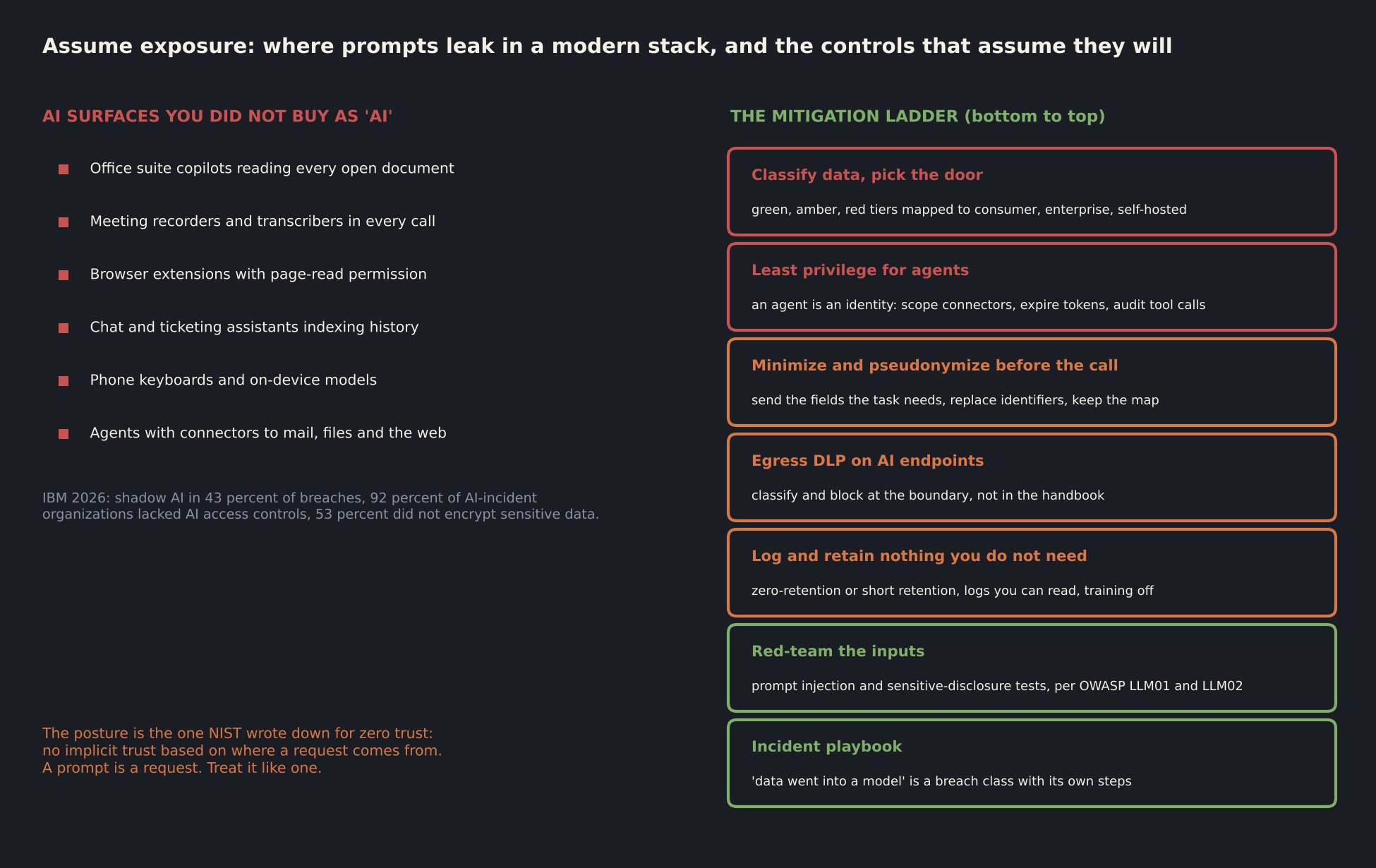
The breach data says this is no longer theoretical. IBM's 2026 Cost of a Data Breach Report, which analyzed 602 breaches across 17 industries, put the global average at a record 4.99 million dollars, found shadow AI involved in 43 percent of breaches, up from 20 percent a year earlier, and reported that 92 percent of organizations with an AI-related incident lacked proper AI access controls while 68 percent had no AI governance policy. Prompt injection attacks averaged 5.89 million dollars per incident. More than half of breached organizations were not encrypting sensitive data at rest or in transit. None of those numbers is about a model being clever. They are about organizations that adopted AI faster than they adopted access control.
So, the mitigation ladder, bottom rung first. Classify data and pick the door. Green, amber, and red tiers mapped to the consumer, enterprise, and self-hosted paths from earlier; if you do nothing else, do this. Treat every agent as an identity. Scope its connectors to the minimum, expire its tokens, log its tool calls, and review its permissions the way you would a service account, because that is what it is. Minimize and pseudonymize before the call. Send the fields the task needs and nothing else, swap identifiers for tokens, and keep the mapping on your side of the boundary; a model that never saw the patient's name cannot leak it. Put DLP on the egress path to AI endpoints, so classification is enforced at the boundary rather than in a document nobody reads. Retain nothing you do not need: zero-retention or short-retention contract terms, training switched off by contract and by configuration, and vendor logs your own team can actually read. Red-team the inputs. The OWASP Top 10 for LLM Applications puts prompt injection and sensitive information disclosure at the top of the list for a reason; test for both before an attacker does. And at the top of the ladder, write the incident playbook. "Data went into a model" is its own breach class now, with its own notification questions, its own vendor contacts, and its own forensic trail. Having the steps written down before it happens is the difference between a contained event and a disclosure.
Notice that none of those rungs is "ban the tool." Every one of them assumes the tool is in use, because it is, and makes the use survivable. That is what congruence with modern practice actually looks like. The organizations in the IBM data that had access controls and governance in place did not avoid AI. They avoided being the 92 percent.
The drive to put AI in everything, and what the returns actually look like
Why is every roadmap suddenly an AI roadmap? Part of it is real capability. Part of it is the board. In the Work Trend Index, 79 percent of leaders said AI adoption was critical to stay competitive, and 66 percent said they would not hire someone without AI skills, while 60 percent admitted their company lacked a vision and plan for implementing it. That combination, mandatory and unplanned, is what produces the memo.
The archetype is Shopify's. In April 2025 Tobi Lütke told the company that reflexive AI use was now a baseline expectation, that AI usage questions would be added to performance and peer reviews, and that teams would need to prove a job could not be done by AI before asking for headcount. His line, "I don't think it's feasible to opt out of learning the skill of applying AI in your craft," was quoted in a hundred other companies' town halls within the month. I do not think he was wrong about the skill. I think most of the companies that copied the memo skipped the part where you measure.
Because here is what the measurement says.
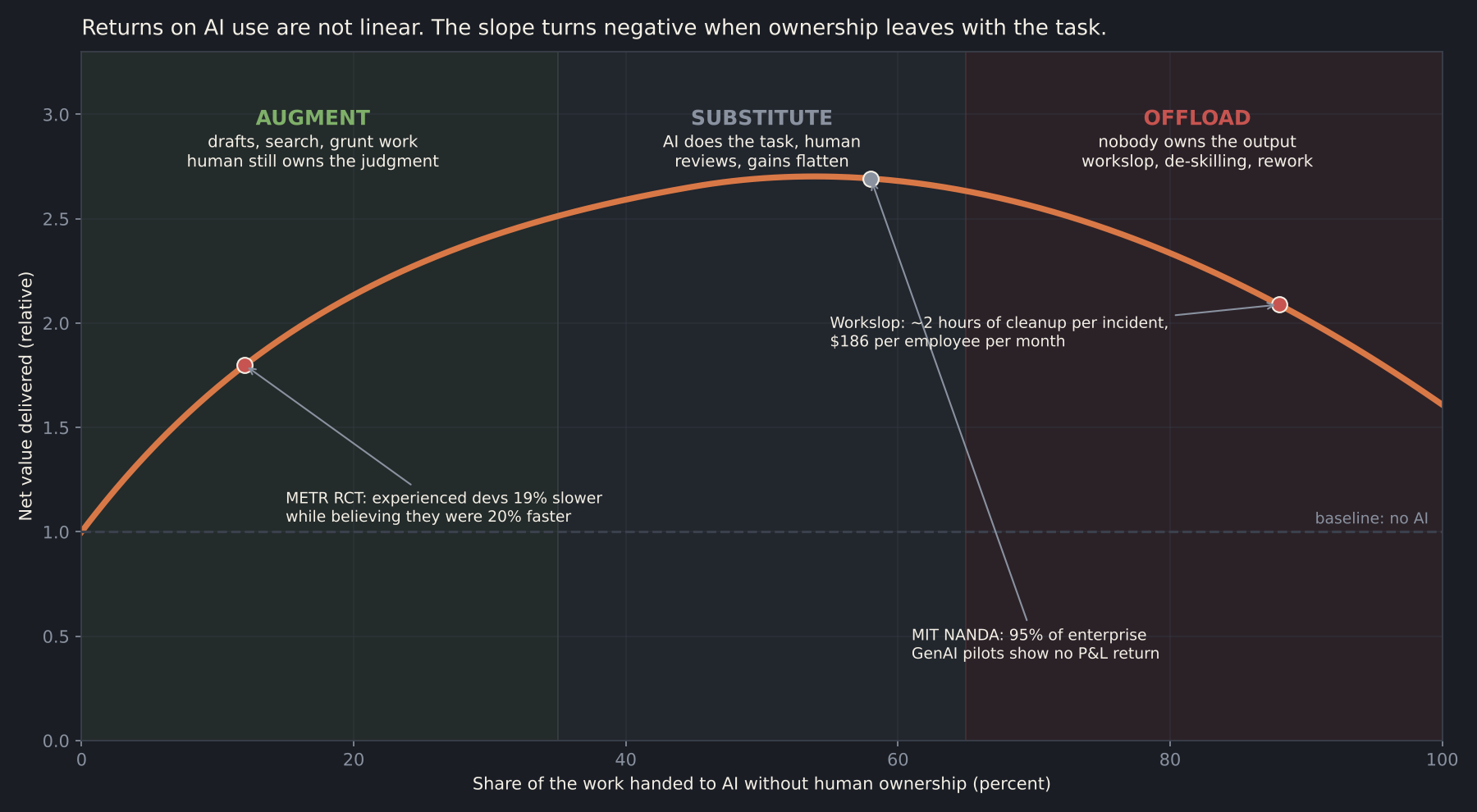
The MIT NANDA report reviewed more than 300 public AI initiatives, ran 52 executive interviews and 153 surveys, and concluded that despite 30 to 40 billion dollars in enterprise spending, 95 percent of organizations were seeing no business return. Five percent of integrated pilots were extracting millions. The split was not about the model. It was about whether the tool was embedded in a workflow with an owner, or bolted on as a chatbot and left to be discovered.
METR ran the cleanest experiment I have seen on individual productivity. Sixteen experienced open-source developers, each with five-plus years on their own large, mature repository, completed 246 real tasks with AI tools randomly allowed or disallowed. The developers predicted AI would make them 24 percent faster. They were 19 percent slower, and after the study they still believed they had been about 20 percent faster. The perception gap is the finding. People cannot feel the slowdown, which is why "I'm so much more productive" is not evidence of anything. I wrote about why the bottleneck moved to review capacity once generation got cheap; the METR result is that same bottleneck measured at the level of one engineer.
And then there is workslop. The Stanford Social Media Lab and BetterUp Labs surveyed 1,150 US workers and found 40 percent had received AI-generated work that looked finished but lacked substance in the past month. Each incident cost the recipient nearly two hours. The authors priced it at 186 dollars per employee per month, or more than nine million dollars a year for a 10,000-person company. The social cost was worse than the time cost: 42 percent trusted the sender less, 37 percent saw them as less intelligent, and 32 percent were less willing to work with them again.
Put those three studies on one curve and the shape is obvious. In the augment zone, where a human still owns the judgment and uses the model for drafts, search, and grunt work, value climbs. In the substitute zone, where the model does the task and a human reviews, gains flatten because review is the new bottleneck. In the offload zone, where nobody owns the output, value goes negative and the organization pays in rework, trust, and skill. The mandate pushes people along the x-axis. Nothing in the mandate tells them where to stop.
The sudden corporate panic about using it too much
Which brings us to the whiplash. The same leadership that wrote the AI-first memo in 2025 is now commissioning studies on whether their people have forgotten how to think.
BCG's June 2026 piece on distributed de-skilling surveyed 70 senior executives and found half were already observing de-skilling in their organizations and more than 60 percent expected it to be a material threat within three to five years. Almost 90 percent cited overreliance on AI outputs without challenge. Fifty-three percent cited slower development of junior talent. Only one company in ten had an actual strategy for it. BCG's recommendations include approved tool lists, required human review, "AI-off zones," and making the ability to challenge AI output a performance criterion. Those are good recommendations. They are also the exact opposite of "prove you can't do it with AI before asking for a human."
The employees noticed the contradiction before the executives did. In the same Microsoft research that found 75 percent adoption, roughly half of AI users said they were reluctant to admit using it for their most important work, because they worried it made them look replaceable. That was 2024. The social penalty has only grown since. The University of Florida and USC surveyed 1,100 professionals and found that 83 percent saw a supervisor's low-AI message as sincere, versus 40 to 52 percent for a high-AI message, and that professionals rated their own AI use leniently while judging their managers harshly for the same thing.
So the signal to a rank-and-file employee in late 2026 is: use it constantly, put it in your review, never let it show, and be prepared to be judged if someone thinks it showed. That is not a policy. It is a loyalty test with moving goalposts.
Same tool, two verdicts: the code is a KPI, the memo is a tell
There is one more incongruity I cannot get past, and it sits at the center of the whole double bind. The same organizations that treat AI-assisted prose as a mark against someone treat AI-assisted code as a headline.
Sundar Pichai told investors in October 2024 that more than a quarter of Google's new code was AI-generated and reviewed by engineers. By Cloud Next in April 2026 the figure he gave was 75 percent. Nobody at that keynote was accused of having a reputation. The 2025 DORA report found 90 percent of technology professionals using AI at work, with a median of two hours a day, and reported that AI adoption now correlates with higher delivery throughput. Stack Overflow's 2025 survey put 84 percent of developers using or planning to use AI tools, 51 percent of professionals daily. Jellyfish's March 2026 benchmark across more than 700 companies found 64 percent had a majority of their code generated with AI assistance. Engineering leaders put these numbers in board decks. They are the proof the transformation is working.
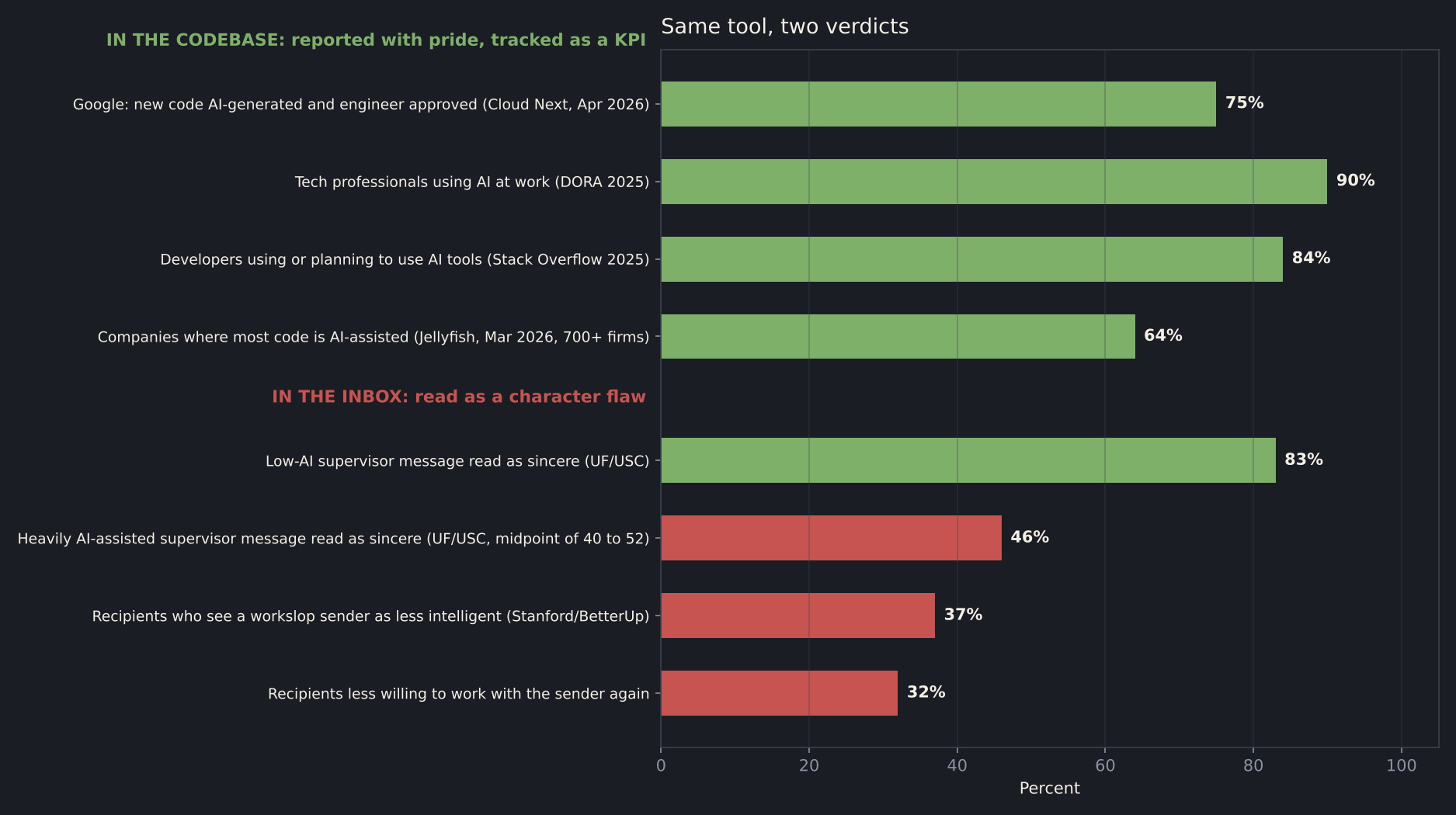
Now put the writing numbers beside them. A supervisor's message rated as heavily AI-assisted is read as sincere by somewhere between 40 and 52 percent of employees, down from 83 percent for the same message with light assistance. A deliverable that reads as AI-generated gets its author labeled less intelligent by 37 percent of recipients. Same tool. Same company. One use is a productivity metric and the other is a personality defect.
I do not think this is entirely irrational, and it is worth being honest about why. Code has a built-in verifier. It compiles or it does not. The tests pass or they do not. The pull request gets reviewed by a peer who can run it. When Google says 75 percent of new code is AI-generated, the operative phrase is "engineer approved," and the organization has a pipeline that makes that approval real. Prose has no compiler. A memo that reads well can be wrong, hollow, or dangerous and nothing in the inbox will flag it. So the suspicion that attaches to AI prose is, in part, a rational response to the absence of a verifier. People are reaching for a social check because there is no technical one.
But that explanation only goes so far, because the data on AI code is not as clean as the keynotes. Veracode's 2026 report found AI-generated code passed its security tests only 56 percent of the time across more than a hundred models. GitClear's analyses of hundreds of millions of code changes have found copy-pasted duplication rising sharply since AI assistants arrived. DORA's own 2025 finding was that AI adoption correlated with higher throughput and higher instability at the same time. The METR trial I cited earlier found experienced developers slower with AI while believing they were faster. The verifier for code is real, but it is not complete, and the organizations celebrating 75 percent AI-generated code have, in most cases, not asked whether their review capacity kept up. Meanwhile, the writer who used a model to restructure a document and then checked every sentence is treated as the risk.
The asymmetry is not about risk. It is about what the organization has decided to count. Code throughput is counted, so AI in code is a win. Written communication is not counted, so AI in writing has no upside to weigh against the social cost, and the social cost is all that registers. If you want to know why a thorough memo gets a side-eye and a 2,000-line AI-assisted pull request gets a thumbs-up, the answer is that someone built a dashboard for one and not the other.
The policy consequence is simple to state and hard to do. Give writing the same structure you gave code: a definition of done, a review step that checks substance rather than style, a disclosure tier, and a measure of whether the thing was useful. I argued in Evals Are the New Acceptance Criteria that AI output needs a verifier before it needs a policy. That applies to the memo as much as the module. Until the organization builds that verifier for prose, it will keep outsourcing the job to whoever in the hallway feels like being suspicious that day.
This week's watermarks, what they actually do, and how they leak
The watermarking story landed on top of all of this, and the timing is not an accident. The EU AI Act's Article 50 transparency obligations took effect on August 2, 2026. Providers of generative systems must embed machine-readable markings in synthetic output and provide a way to detect them, with fines up to 15 million euros or 3 percent of global turnover. Systems already on the market have until December 2, 2026. The Commission's voluntary Code of Practice gives signatories a presumption of conformity, and several major providers signed it.
Anthropic published its approach on August 14. Reporting on the customer email that followed says the mark is being extended to four older Claude models starting November 3, with the newest models having shipped with it from day one. xAI's developer docs say Grok API output will be watermarked by default from November 7 across seven models, with a response header that tells you whether a given request was marked. Google has been doing this with SynthID for a while. The era of unmarked frontier model output is, for practical purposes, over.
It is worth being precise about what these marks are, because almost every reaction I have read gets the mechanism wrong.
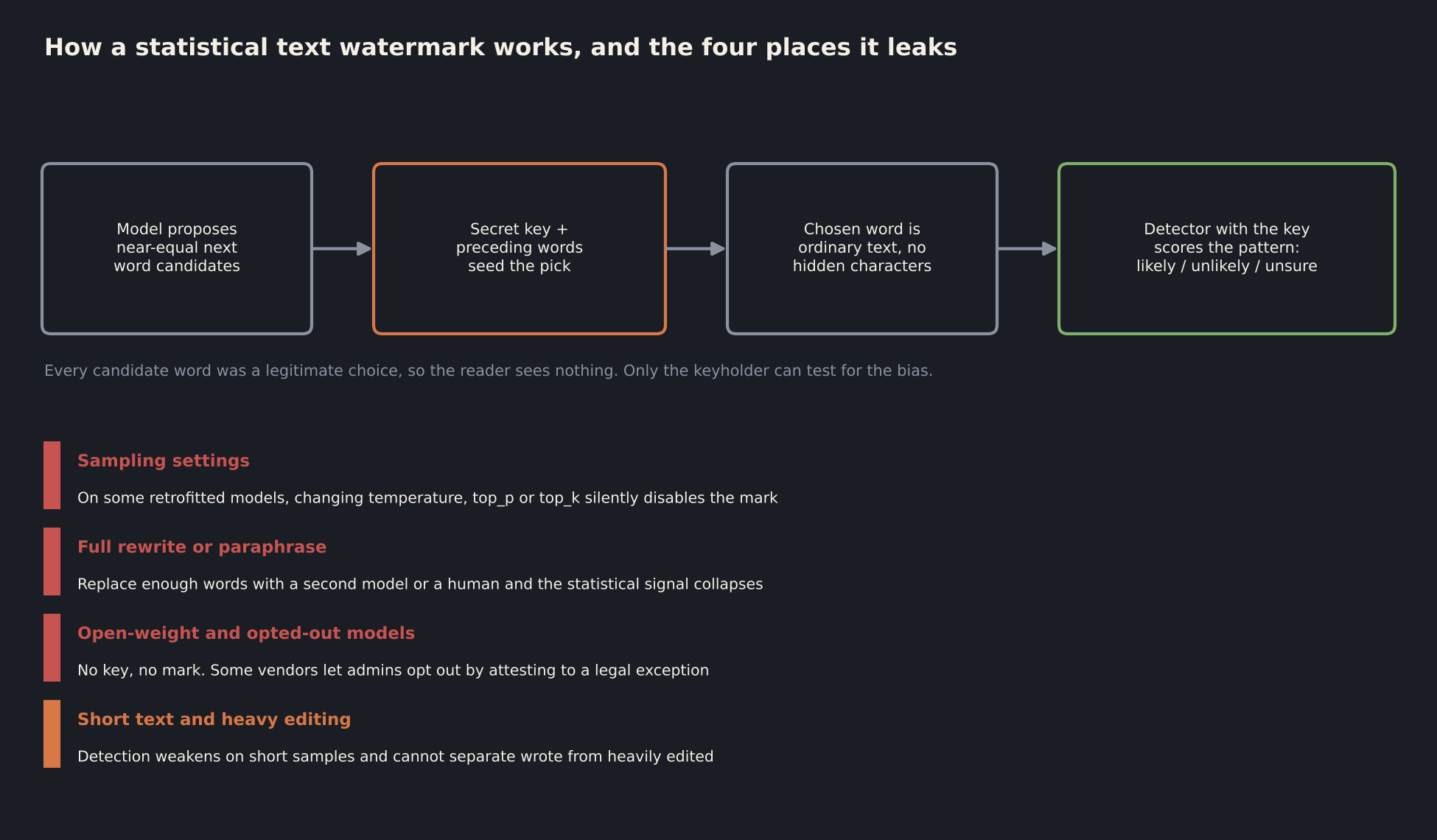
There are no hidden characters. This is not a zero-width Unicode trick or a metadata field. The approach descends from DeepMind's SynthID-Text work, published in Nature in October 2024. When the model is choosing the next word and several candidates are nearly equally good, it no longer picks among them at random. A secret key combined with the preceding few words seeds the choice. Every word that comes out was a legitimate word the model might have chosen anyway, so the text reads normally, costs no extra tokens, and contains nothing a reader can see. Only someone holding the key can test a passage for the statistical bias. Anthropic's write-up says the mark gets sparser on factual text and code where exact output matters, that it survives translation and light editing, and that "a complete rewrite where every word is replaced will" remove it.
What a detection result means is narrower than the headlines suggest. Anthropic's own page says the detector reports the likelihood that text was partly written by Claude, cannot identify other systems, is weak on short samples, and cannot distinguish "Claude wrote this" from "Claude heavily edited this." The detection API is in private preview for regulators, law enforcement, media, fact-checkers, researchers, educational institutions, and enterprises with documented compliance obligations. Your manager does not have it. Your IT department probably does not either, yet.
And the leaks are real. Four of them, documented this week:
- Sampling settings. Reporting on Anthropic's customer email says that on two of the retrofitted models, changing temperature, top_p, or top_k from their defaults silently disables the mark. No error, no warning. Anyone who has tuned a production prompt knows how common non-default sampling is.
- Full rewrite or paraphrase. Run marked text through a second model, or through a human who rewrites it, and the statistical signal collapses. The vendors say this themselves.
- Open-weight and opted-out models. A model you run yourself has no vendor key and no mark. xAI's docs let a team admin opt out per model by attesting that a legal exception applies and accepting responsibility for disclosure. The opt-out is logged, but it is a checkbox.
- Short text and heavy editing. A three-sentence email is below the detection floor. A long document that a human substantially reworked may still carry a mark, and the detector cannot tell you how much of it was the human.
The backlash was immediate and, to be fair to the people complaining, not entirely irrational. One Reddit commenter quoted by Futurism said people would come "out of the process with a digital tattoo on their forehead." Another said the mark "will be the kiss of death on any piece of text that people can sell." Biggo reported some users canceling subscriptions in protest. Civil society groups made the opposite complaint: WITNESS argued the Code of Practice makes real provenance information optional while requiring only a binary mark, leaves open-weight models unenforceable, and exempts the personal-use deepfakes that do the most damage.
My read, as someone who has to write policy around this: the watermark is a compliance artifact, not a forensic instrument. It will let a regulator or a newsroom check whether a specific long document probably passed through a specific vendor's model. It will not tell an employer whether an employee used AI, because the detector is restricted, the bypasses are trivial, the mark cannot separate authorship from editing, and the absence of a mark proves nothing at all. The one thing it will reliably do is raise the ambient suspicion level, which is the last thing the people in the next section needed.
That suspicion has a market now, and that is the part worth watching. Watermark detection is restricted today, but the commercial AI detectors that predate it are not, and they are already being bought by HR departments, hiring platforms, publishers, and freelance marketplaces as if they were instruments. They are not instruments. They are heuristics with a confidence slider. The next section is about what those heuristics do when they are pointed at people.
The accusation problem, and why thoroughness became a liability
Here is where I want to go hard, because this is the part that is damaging careers right now and almost nobody in leadership is treating it as a failure.
Someone I know, highly educated and working in a role where long written analysis is most of the job, was told that they were developing a reputation for leaning on AI too much. The evidence was secondhand: a handful of remarks relayed from elsewhere in the organization, the most recent from a person in a different department who rarely interacts with them beyond meetings and document comments. Their actual AI use over the prior year amounted to a single project, where they and a coworker used a model to sort through more than a million records that nobody wanted to classify by hand. Everything else, including the long, carefully structured replies that prompted the remarks, was written the way they have always written. When they asked how they could communicate thoroughly without being read as a machine, the advice was to keep messages shorter and move more of the conversation into meetings.
Read that advice again. A skilled writer was told to be less clear, less complete, and more synchronous, so that they would seem more human to people who have decided that competence is a tell. There is no version of that which is good for the organization. It trades written, searchable, reviewable communication for hallway conversations nobody can audit, and it does so to accommodate a heuristic that is wrong.
It is wrong in a measurable way. The tells people rely on, consciously or not, are the same ones the commercial detectors use: low perplexity, which means predictable word choices, and low burstiness, which means consistent sentence length and structure. Those are also the defining features of formal, edited, professional prose. The Stanford team led by Weixin Liang tested seven commercial detectors on 91 essays written by real humans for the TOEFL exam and found an average false positive rate of 61.3 percent, with 97.8 percent of the essays flagged by at least one detector. Essays by native speakers were flagged in the single digits. The detectors were not finding AI. They were finding a narrower vocabulary and more uniform sentence rhythm, which is what careful, formal, second-language prose looks like, and what a lot of trained professional prose looks like too. The tools had learned to flag the absence of slang and the presence of structure. That is a description of a good technical document, not of a machine.
When a Python script gets mistaken for a model
There is a version of the false accusation that deserves its own paragraph, because it catches the most technical people in the room and because the remedy is clean. A great deal of what gets flagged as "AI" is not generative at all. It is automation: a Python script that reads a spreadsheet and writes a paragraph per row, a Jinja template that renders a status report from a ticket query, a SQL job that produces the same table every Monday, a regex pass that normalizes formatting across a thousand files, a mail merge. The million-record project in the story above was almost entirely this kind of work. These methods predate large language models by decades. I have written about building delivery visuals with Python and automating Jira for years, and nobody called it AI until 2023.
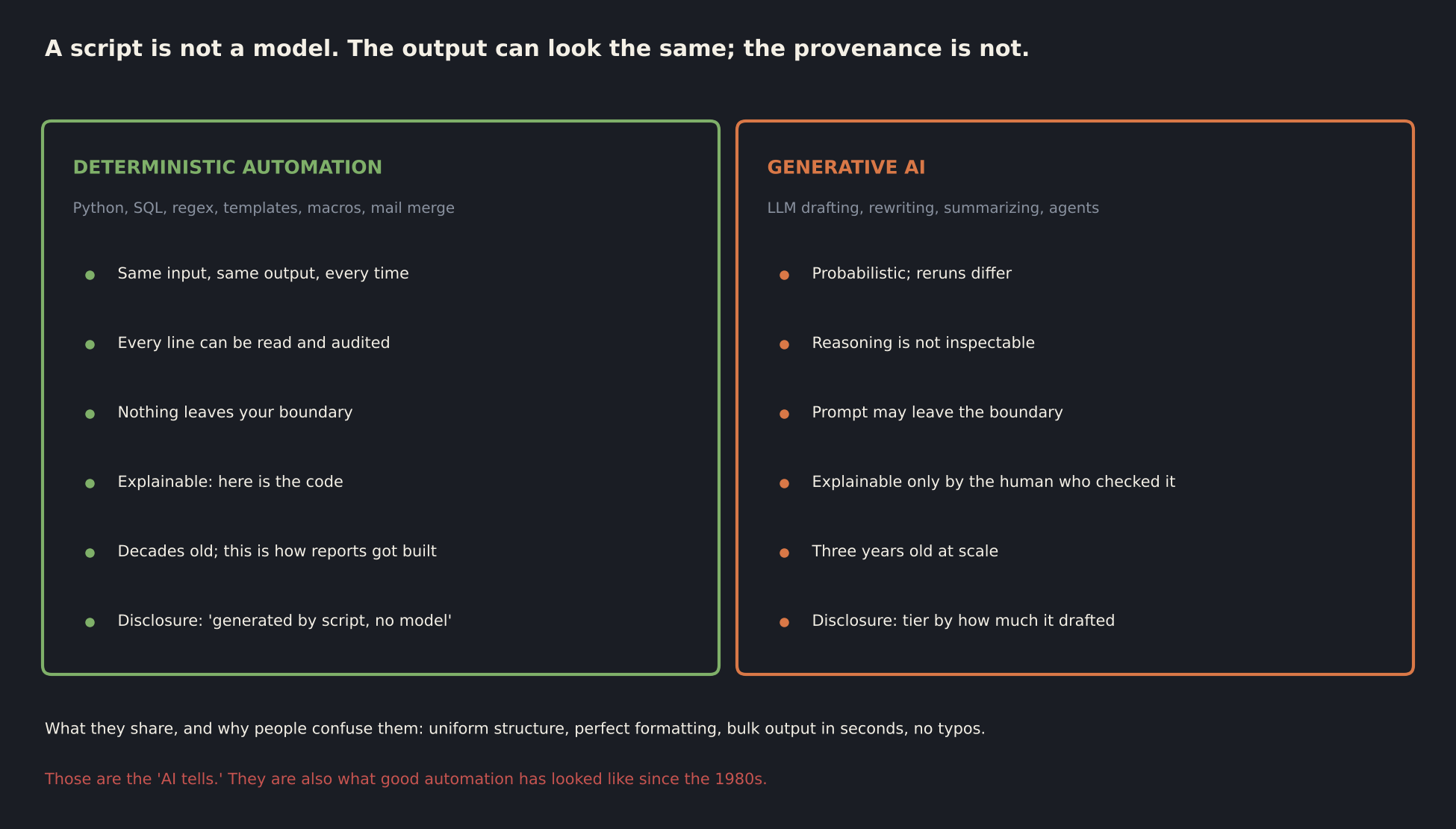
The reason the confusion happens is that automation produces exactly the surface features people have learned to call AI tells: uniform structure, perfect formatting, no typos, and a volume of output that no human could type in the time available. Those are the signatures of a script doing what scripts do. They are also, as it happens, what the commercial detectors key on, which is why a templated report will light up a detector faster than a model-drafted email will.
The fix is that automation has something generative AI does not: inspectable provenance. A script is deterministic. The same input produces the same output every time. Every line can be read, and the data never left the machine it ran on. So the response to "did you use AI for this" is not a denial, it is an artifact. Here is the script. Here is the input. Here is the commit. Run it yourself. I tell people in technical roles to make that reflexive: keep the code in a repository, put a one-line provenance note in the deliverable ("generated by build_report.py from the export of November 1"), and treat the script as part of the deliverable rather than a private shortcut. It costs nothing, and it converts an unfalsifiable accusation into a checkable claim.
The policy side matters too. An acceptable-use policy that does not distinguish deterministic automation from generative AI will produce exactly this confusion, because it has handed managers one word for two different things. The disclosure tiers I lay out at the end of this post treat "generated by a script, no model involved" as its own category, separate from light AI assistance and from substantial AI drafting. That one distinction removes an entire class of false accusations, and it has the side benefit of reminding everyone that a good automation engineer was valuable before the models arrived and is more valuable now.
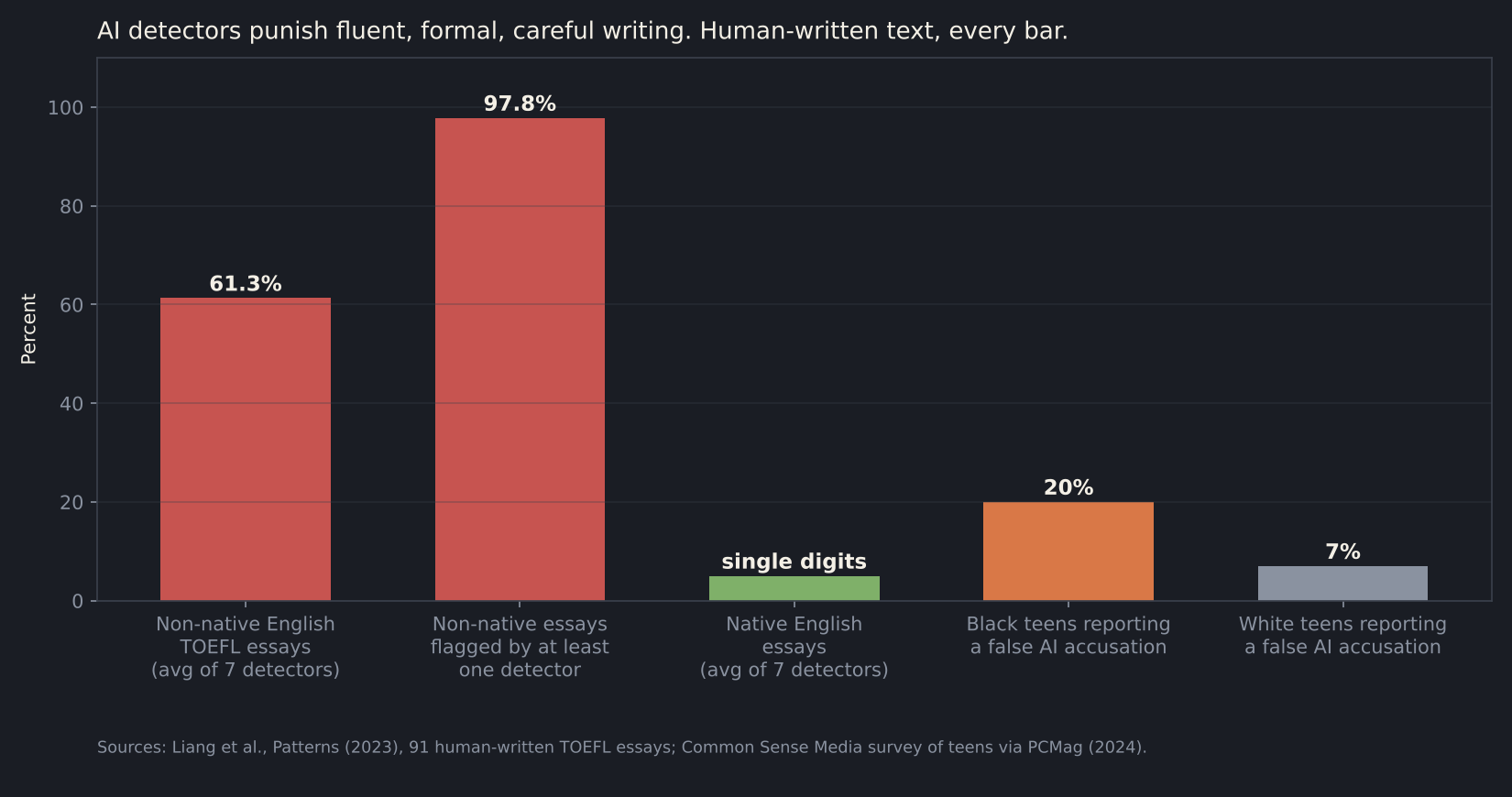
The human version of the detector has the same bias with worse demographics. A Common Sense Media survey found 20 percent of Black teens reported being falsely accused of using AI on schoolwork, against 7 percent of white students. In 2023 a Texas A&M instructor accused an entire class after asking ChatGPT whether it had written their essays, a method with no validity whatsoever. Universities learned the lesson faster than employers: Waterloo switched Turnitin's AI detector off after an internal trial flagged human writing as 100 percent generated, and Yale, Johns Hopkins, Vanderbilt, and others now bar the score from being used as evidence. Arvind Narayanan at Princeton did the base-rate math: even with a vendor's claimed one-in-ten-thousand false positive rate, a student submitting 500 to 1,000 assignments over four years has a 5 to 10 percent chance of being falsely accused at least once.
What detection software does to the people under it
It is worth pausing on the human cost of these tools, because the vendors describe them as risk management and the people on the receiving end describe them as something else. Freelance marketplaces are full of writers who have lost clients to a detector score they cannot contest. Students have had grades held, and integrity cases opened, over a percentage from a tool whose own maker will not publish a peer-reviewed false positive rate, which is why universities started pulling the scores from their proceedings. In the workplace there is rarely even a tool, just a manager who ran a paragraph through a free website, got a number, and now has a conversation to start. The accused person cannot cross-examine a score. They cannot ask what it was trained on. They cannot see which sentences triggered it. The asymmetry is total, and it lands hardest on exactly the populations the Stanford data predicted: people writing in a second language, people with formal training, and, as MIT's own committee noted this summer, neurodivergent writers whose prose does not vary the way the detector expects.
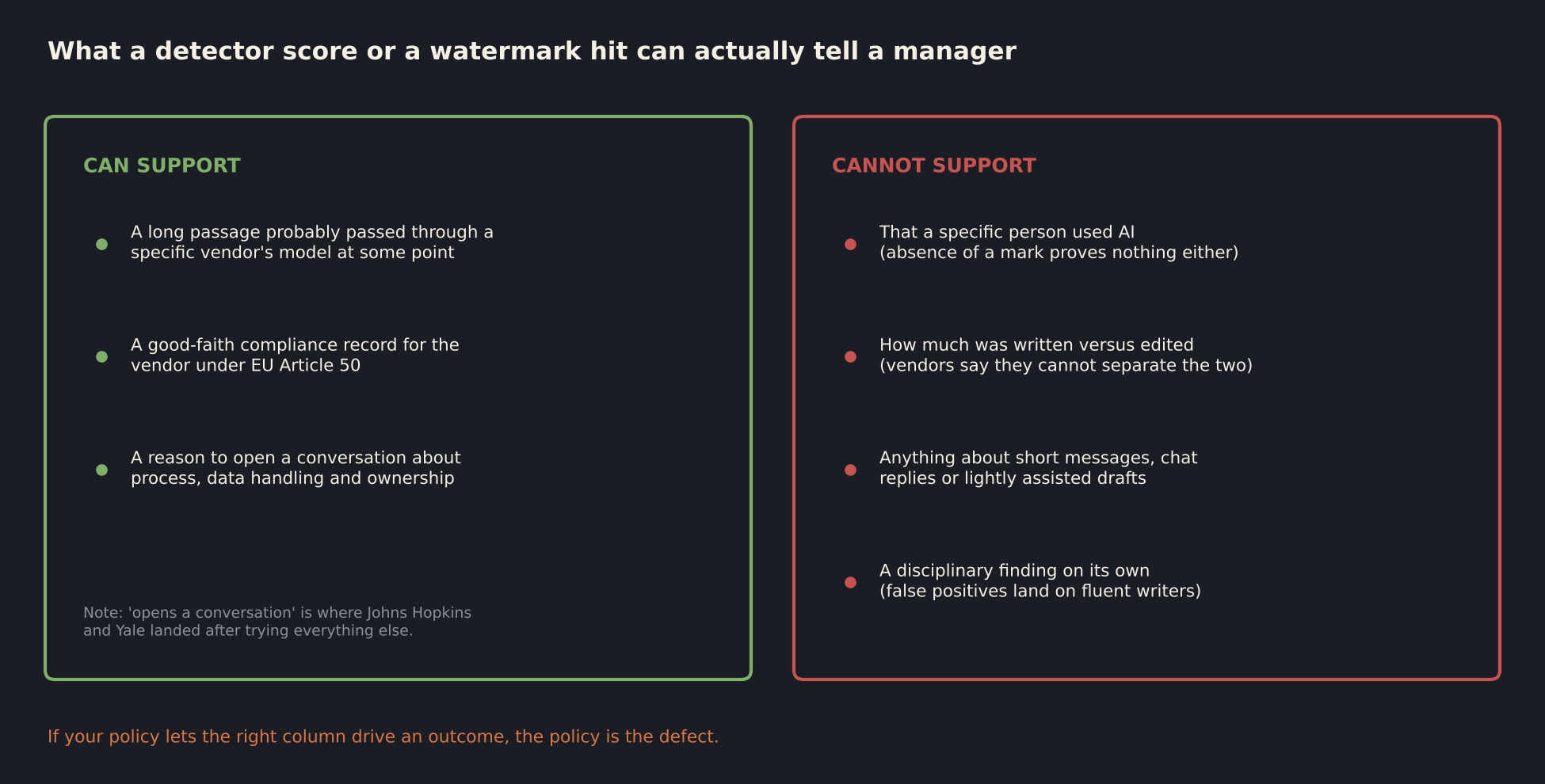
The watermarks will not fix this, and may make it worse for a while. A watermark hit is more credible than a detector score because the vendor holds the key, which means a positive result will carry more weight in a room even though the vendor itself says it cannot separate "wrote" from "heavily edited" and says nothing at all about short text. Expect a period where a credible-sounding signal is applied to questions it was never designed to answer, by people who have not read the vendor's caveats. The right posture for any organization is to decide, in advance and in writing, what a detection result is allowed to trigger. The defensible answer is a conversation about process, data handling, and ownership. The indefensible answer is a finding.
What MIT did instead
The institution that produced the GenAI divide report also, this year, produced the clearest example I have seen of a policy that resolves the double bind rather than deepening it. MIT's Ad Hoc Committee on AI Use in Teaching, Learning, and Research Training released its report in August 2026, and its Appendix B gives every course a menu of four policies to choose from and requires each class to pick one and explain the rationale to students.
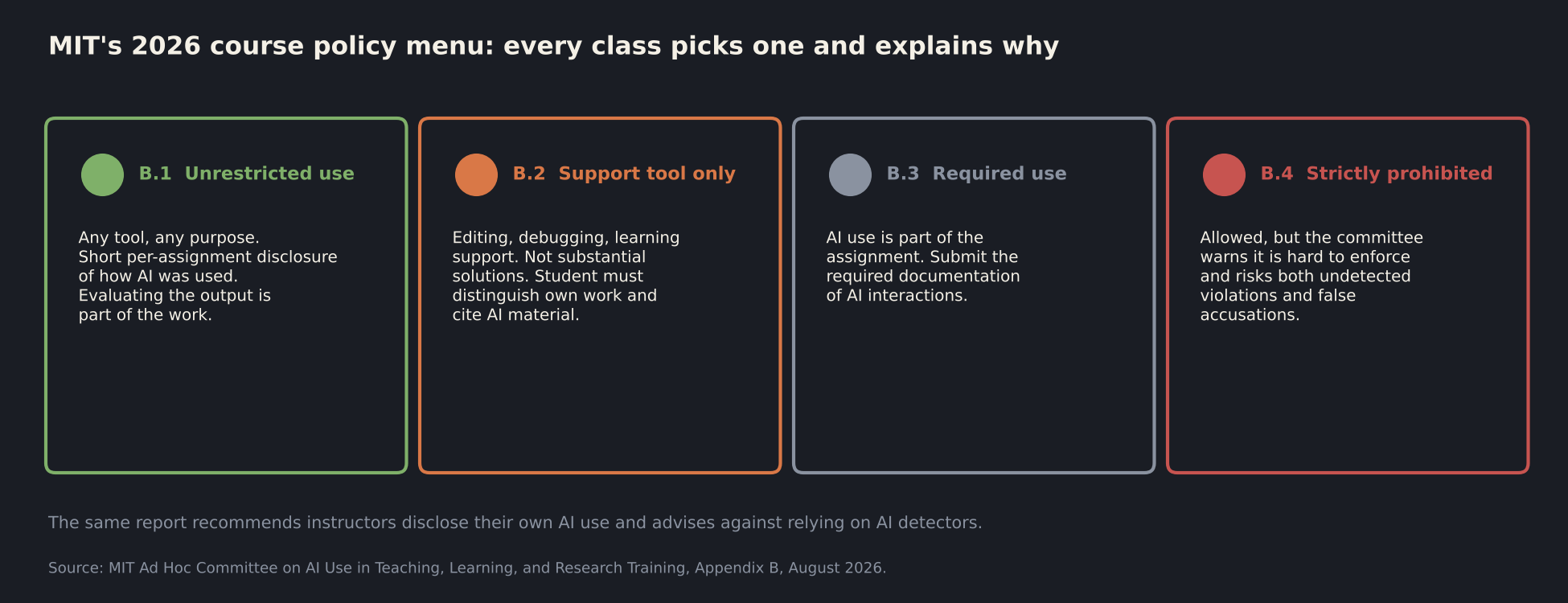
The unrestricted option lets students use any tool for any purpose, asks for a short per-assignment disclosure of how the AI was used, and states plainly that evaluating and integrating the output is itself part of the work. The support-tool option allows AI for editing, debugging, and learning support but not for substantial solutions, and requires students to distinguish their own work and cite AI-generated material. The required-use option makes AI part of the assignment and asks for documentation of the interactions. And the prohibition option is still on the menu, but the committee attaches a warning that it is "difficult to enforce reliably and may create risks of both undetected violations and false accusations." The same report recommends that instructors disclose their own AI use when they use it to generate content or to grade, and it advises against relying on AI detectors because of the risk of misflagging non-native speakers and neurodivergent students.
Notice what that framework does. It moves the question from "did you use it" to "say how you used it, and stand behind the result." Disclosure replaces detection. Accuracy and explainability replace provenance. The student who used a model to draft and then rewrote every paragraph is treated the same as the student who used it to check their math, because both of them can explain what they did and both of them own the answer. A university with more at stake in academic integrity than almost any employer has in deliverable integrity looked at the detection approach, measured it, and walked away from it. Employers who are still buying detector licenses in 2026 are behind the schools.
Now carry that into the workplace, where there is no detector at all, only vibes. The accusation "you sound like AI" is unfalsifiable. You cannot prove a negative about your own writing process. If you respond with a thoughtful, well-organized explanation, you have just produced more evidence. If you respond with a terse one, you have conceded the point. The only winning move is to have been sloppy all along.
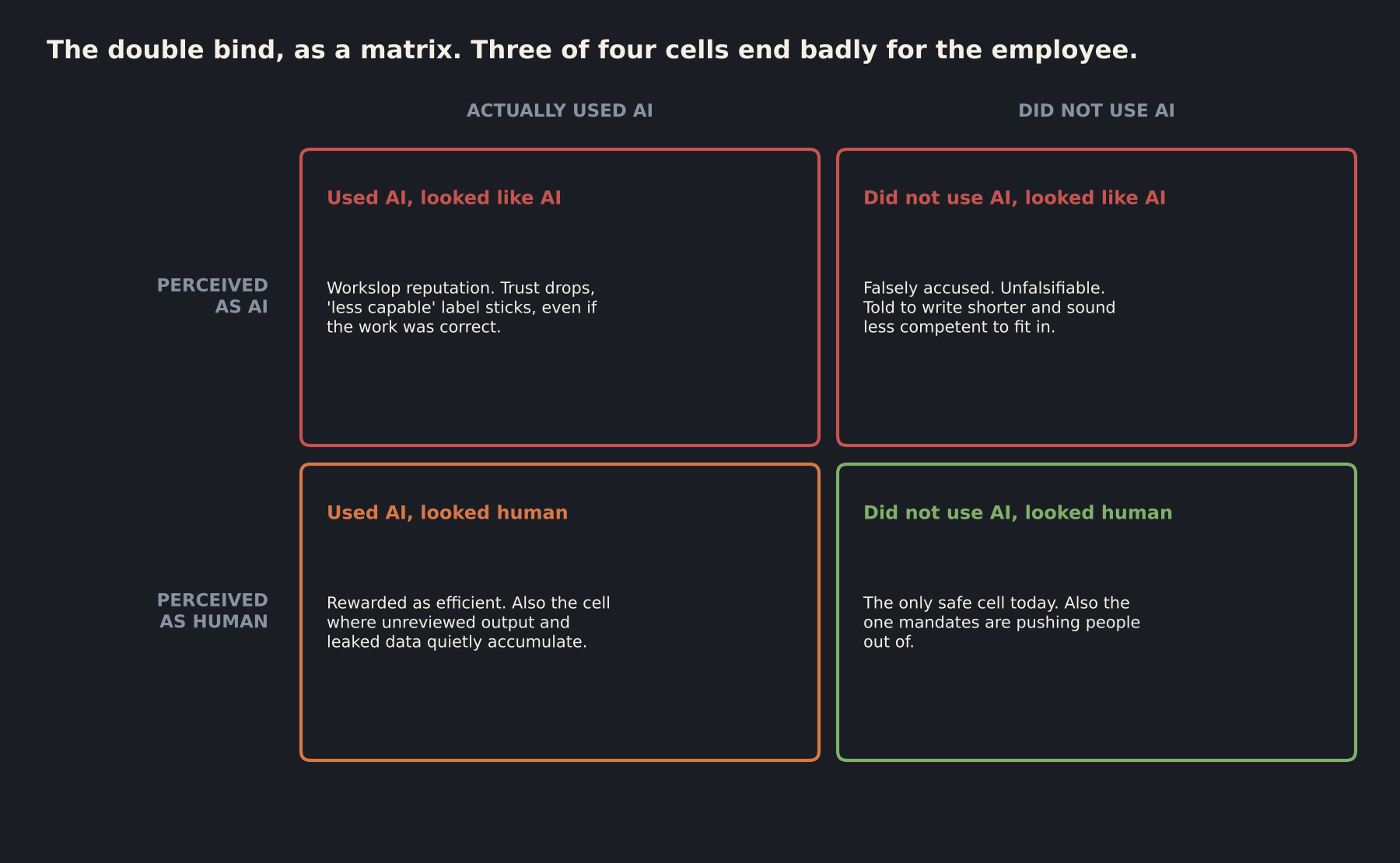
Lay it out as a matrix and three of four cells end badly. Use AI and look like it, and you get the workslop reputation: less capable, less trusted, even if the work was correct. Do not use AI and look like it, and you get the false accusation plus advice to dumb down. Use AI and look human, and you are rewarded, which is also the cell where unreviewed output and leaked data quietly accumulate because nobody is checking the person who seems fine. The only safe cell is the one the mandates are pushing everyone out of.
The reporting chain nobody has to stand behind
There is a specific dynamic underneath all of this that deserves its own name, because it is where the career damage actually happens. Call it the reporting chain. A coworker reads a thorough reply and thinks "that's AI." They mention it to someone, as an observation, not a complaint. That person relays it upward, and by the time it reaches leadership it has become "people are saying." Leadership raises it with the employee as a reputation issue rather than a finding, because there is no finding; there is no artifact, no log, no standard, just an accumulation of remarks. And the employee is left to argue against a claim nobody made in a form that can be examined.
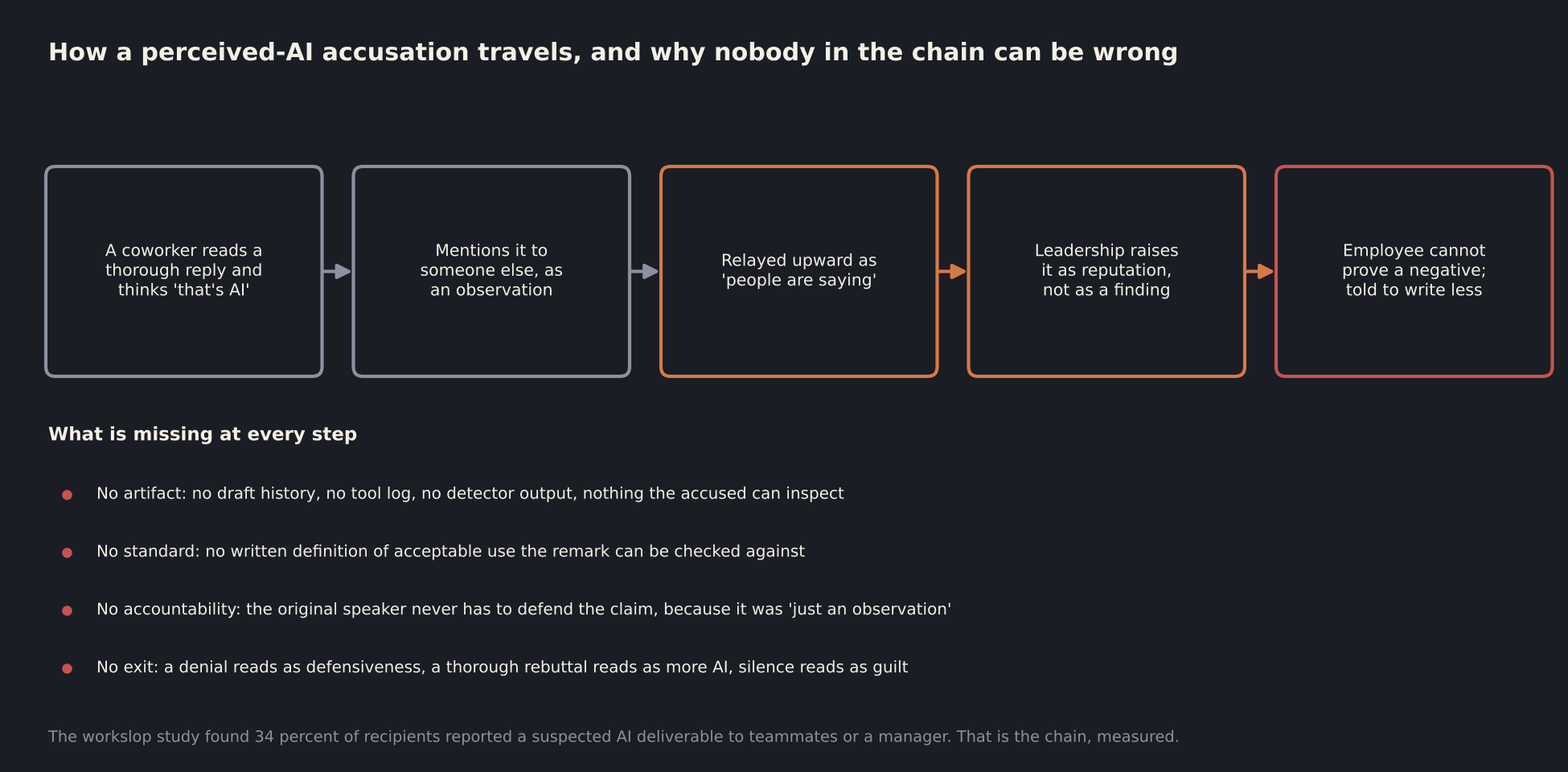
This is not hypothetical. The workslop researchers found that 34 percent of people who received a suspected AI deliverable reported it to teammates or a manager. One in three. That is the chain, measured, and it fires whether the suspicion was correct or not. Combine it with the Microsoft finding that about half of AI users hide their use from colleagues, and you have a workplace where the people using AI are quiet about it, the people who suspect AI use are vocal about it, and the signal that reaches leadership is composed almost entirely of the second group's impressions.
From an HR standpoint it is close to the worst case. There is no complainant, so there is no one to interview. There is no policy violation alleged, so there is nothing to investigate. There is no artifact, so there is nothing to review. And yet a reputation has been attached to someone's name, it has been raised in a performance context, and it will be remembered at calibration time. The accused employee has three moves, and all of them lose. Deny it, and that is defensiveness. Rebut it in detail, and that is more evidence of the thing being alleged. Say nothing, and that is an admission. A grievance process built for actual complaints has no slot for "people are saying."
The chain also quietly rewards the wrong behavior. The person who started it bears no cost, because they only made an observation. The person who relayed it bears no cost, because they were just passing along what they heard. The manager who raised it bears no cost, because they were being transparent. The only person who pays is the one who did the work, and the thing they pay with is the instruction to do less of it. Any organization that lets an unverified impression travel that far without anyone having to put their name on a specific claim has built a mechanism for punishing thoroughness, and it will get exactly the output it is paying for.
The fix is procedural and dull, which is why it works. A concern about AI use is handled like any other concern about work product: it is tied to a specific deliverable, it names the problem with that deliverable, and it is raised with the author directly by the person who has it. If the concern is "this was wrong," say what was wrong. If the concern is "this leaked data," say what leaked. If the concern is "this did not disclose substantial drafting and the policy required it," say so. If the only concern is "this sounds like a model," there is no concern, and the right response from the manager who hears it secondhand is to say exactly that and let it die there.
I want to name what is actually happening in meetings, because I have sat on the manager's side of that table too. The manager is not evaluating the work. The work was fine. The manager is relaying a social signal, and the social signal is a proxy for something else: the person is more thorough than the people around them, and thoroughness now reads as inhuman. Twenty years ago the same signal would have been phrased as "you come across as a know-it-all." The vocabulary changed. The pettiness did not. What changed is that the new vocabulary has a technology attached, and the technology has a mandate attached, which gives the complaint a veneer of policy it never earned.
If you manage people, here is the rule I would ask you to adopt today: you evaluate output, not only provenance. Is it correct? Does the author stand behind it, and can they defend it in a conversation? Did it leak anything it should not have? Did it stay inside the AI use policy the organization actually wrote down? And was it helpful, meaning did it move the work forward and deliver something the reader needed? Those five questions cover every real risk of AI use and every real benefit. Provenance matters only as far as the policy makes it matter: if the policy says disclose substantial drafting, then not disclosing is a finding, and that is the end of provenance's role. "Does it sound like a model" covers none of those questions, and it punishes exactly the people you should be promoting.
What acceptable use will look like by 2030
I will put my own stake in the ground. These are predictions, not hopes, and some of them I dislike.
Provenance will replace detection, and the burden will flip. Within three years the question will not be "did you use AI" but "what does the content credential say." The same C2PA-style content credentials now attached to images will be attached to documents and code commits. A document will carry a signed record of which tools touched it, in the same way a change carries its pipeline evidence, something I described for release management in Change Advisory Boards Can't Keep Up With Agents. The honest version of this is a nutrition label: "drafted by a model, edited by the author, reviewed by a peer." The dishonest version is a surveillance log. Which one your company gets depends on who writes the policy first.
The watermark arms race will run its course and end in a stalemate that favors disclosure. Paraphrase laundering will be a commodity service by next year, probably built into the same tools that add the mark. Open-weight models will stay unmarked. Detection APIs will stay restricted because broad access is exactly what you would need to build a scrubber. Regulators will accept the mark as evidence of good-faith compliance by the provider, and courts will refuse to accept it as evidence of anything about an individual. Employers who try to discipline on a detector score will lose grievances and, eventually, lawsuits, the same way universities already have in spirit. The practical result is that watermarks end up governing vendors and disclosure ends up governing people.
Acceptable-use policies will converge on data tiers, not tool bans. The companies that get this right will stop publishing lists of forbidden apps and start publishing data classifications. Green data can go through any approved door. Amber data goes only through the enterprise door with training disabled and retention set. Red data, which is PHI, source code, customer records, and contract terms, goes only through a BAA-backed or self-hosted path and never through a connector that was not scoped for it. The agent layer gets its own section, because an agent's reach is a permission question and not a tool question. This is the same risk-tiered lane model I keep landing on for change approval, and for the same reason: human attention is finite and should go to the top tier.
"AI-off zones" will become normal and will be resented. BCG is right that organizations will carve out work that must stay human-led, and they will do it for de-skilling reasons rather than quality reasons. Junior engineers will be required to ship some code without assistance so they develop judgment. Analysts will be required to build some models by hand. This will feel like being made to do long division. It will also be the only thing that keeps the senior bench from emptying out in a decade. The companies that skip it will discover the problem the first time an incident needs someone who can reason without a copilot.
The accusation problem will get worse for two or three years before it gets better. Watermark news raises the ambient suspicion. Mandates raise the volume of actual AI output, so the base rate of machine-shaped prose goes up, so the heuristic feels more justified even as it misfires on more people. Expect HR complaints, expect the first wrongful-discipline cases over "AI reputation," and expect formal policies by 2028 that prohibit adverse action based on perceived AI use without evidence of a data or quality violation. We already have the template: universities got there in under three years once the false positive data was undeniable.
Human-written will become a premium label, and the people most able to earn it will be the ones most often accused. You can already see "no AI was used" appearing on newsletters and proposals the way "handmade" appears on furniture. The irony is that the writers best positioned to claim it, the ones with training and range and the patience to structure a long argument, are the ones producing the low-perplexity, low-burstiness prose that reads as synthetic. The market will sort this out with reputation and provenance rather than detection, but the sorting will be ugly.
Relationship communication will quietly retreat from AI, and that will be healthy. The University of Florida sincerity numbers are the leading indicator: when a supervisor's message was described as heavily AI-assisted, the share of employees who read it as sincere fell from 83 percent to roughly half, and that was for a congratulatory note, the lowest-stakes relational message there is. People forgive a model-drafted status report and do not forgive a model-drafted condolence. The norm that settles out will be: automate the transactional, write the relational yourself, and disclose when you are not sure which one you are doing. The "my AI talks to your AI" loop in performance reviews will be looked back on as a two-year embarrassment.
And the companies that win will be the ones that measure. Not adoption. Not licenses. Not "percent of employees using AI" on a slide. The metrics that matter are the ones the returns curve points at: rework rate on AI-assisted deliverables, review time per artifact, defect escape rate by provenance tier, time-to-competence for juniors, and incidents traced to data that went through the wrong door. The five percent in the MIT study were the ones with an owner and a number. Everyone else had a memo.
What I would actually put in the policy
Since someone will ask, here is the skeleton I would hand a leadership team tomorrow.
- Classify data, not tools. Three tiers. Name what goes in each. Name the approved door for each tier.
- Require the enterprise door for anything above green. Training off, retention set, logs on, SSO enforced. Personal accounts for work data are a policy violation, full stop, and the company has to provide a sanctioned alternative on day one or the rule is theater.
- Treat agents as a permission grant. Every connector an agent can reach is a data flow that needs the same classification review as a human account with that access.
- Assume exposure and build the ladder. Classify, scope agents, minimize before the call, DLP at egress, retain little, red-team the inputs, and write the incident playbook before you need it.
- Evaluate output, not only provenance. Correctness, ownership, data handling, and whether the deliverable actually added value for the person who needed it are the legitimate grounds for feedback. A helpful, accurate, well-owned piece of work is good work regardless of which tools touched it. Provenance enters only where the disclosure tier requires it. "Sounds like AI" is not a finding.
- Disclose by tier, not by shame. Deterministic automation (a script, a template, a query) gets a provenance note and is not AI use. Light AI assistance needs no disclosure. Substantial drafting gets a one-line credit. Full generation gets a label. Make the label normal so that nobody has to hide.
- Protect the humans who write well. Put it in writing that thoroughness, structure, and polish are not evidence of AI use and will not be treated as such.
- Keep some work human by design. Name the AI-off zones and explain why they exist, so they read as apprenticeship rather than punishment.
- Measure rework and review time, not adoption. Report them next to the adoption number every quarter, so the curve is visible.
None of that is complicated. All of it is harder than sending a memo, which is why the memo keeps winning.
The thing nobody wants to say out loud
The contradiction at the center of this is not a technology problem. The watermark works roughly as advertised. The models are useful. The BAAs exist. The data about returns and de-skilling and workslop is clear and recent and mostly consistent.
The contradiction is that organizations adopted a tool faster than they adopted an opinion about it. They mandated use without defining good use, bought licenses without classifying data, and then, when the predictable social friction arrived, let it land on individuals instead of fixing the system. A skilled writer being told to write worse so that they seem more human is not an AI story. It is a management story in which AI is the excuse.
The fix is the same one it always was: decide what good looks like, measure it, and defend the people who deliver it. The models will keep getting better, and the marks will keep getting subtler. Whether your organization is still able to tell competence from automation in five years depends on whether you build that muscle now or outsource it to a heuristic that was wrong on day one.
References
- Microsoft and LinkedIn. 2024 Work Trend Index Annual Report: AI at Work Is Here. Now Comes the Hard Part. news.microsoft.com
- The Decoder. AI shame at work is a thing, according to a Microsoft study. the-decoder.com
- Nightfall AI. 2026 AI Agent Risk and Action Report. nightfall.ai
- MIT NANDA, via Virtualization Review. MIT Report Finds Most AI Business Investments Fail, Reveals GenAI Divide. virtualizationreview.com
- Jacqueline Munis. Fortune. Social offloading: employees are outsourcing empathy to AI. fortune.com
- Bloomberg. Samsung Bans ChatGPT and Other Generative AI Use by Staff After Leak. bloomberg.com
- Medcurity. Can You Put PHI Into an LLM? HIPAA Rules for Using AI With Patient Data. medcurity.com
- Accountable HQ. ChatGPT Enterprise HIPAA Compliance: What You Need to Know. accountablehq.com
- eMarketer. Shopify sets AI use as core expectation for workers. emarketer.com
- Abi Noda, DX. METR study on how AI affects developer productivity. getdx.com
- The Decoder. AI-generated workslop is costing companies millions and hurting team morale, study finds. the-decoder.com
- Sarah Bregel, Fast Company. AI is creating workslop. fastcompany.com
- Boston Consulting Group. When Everyone Uses AI, Companies Risk Losing Critical Skills. bcg.com
- University of Florida News. Is writing with AI at work undermining your credibility? news.ufl.edu
- Cooley LLP. EU AI Act: Transparency Obligations Take Effect 2 August 2026. cooley.com
- Anthropic. How Claude's text watermarking works. anthropic.com
- GPTOnline. Anthropic Adds Claude Watermark To Four More Models Nov 3. gptonline.ai
- TechTimes. Anthropic Claude Watermark: Silent Bypass on Opus 4.6 and Sonnet 4.6 Production Calls. techtimes.com
- xAI Developer Docs. Output Watermarking. docs.x.ai
- Futurism. People Horrified That They'll Be Busted Now That Anthropic Is Watermarking AI Content. futurism.com
- BigGo Finance. Developers Push Back Against Copy-Pasting AI Responses, Watermark Disclosure Debate Emerges. finance.biggo.com
- AI Weekly. EU AI Act transparency rules go live with major gaps. aiweekly.co
- Weixin Liang et al. GPT detectors are biased against non-native English writers. Patterns, 2023, summarized at workingeducators.org
- Cloud Security Alliance. Shadow AI Apps: The Enterprise Attack Surface That Outpaces Monitoring. labs.cloudsecurityalliance.org
- Craig Hale, TechRadar. Shadow AI becomes a massive enterprise liability, PagerDuty study. techradar.com
- Teramind Research. The Shadow AI Behavior Report 2025 to 2026. teramind.co
- MIT Ad Hoc Committee on AI Use in Teaching, Learning, and Research Training. Appendices, including the Appendix B course policy menu. aiandeducation.mit.edu
- Harvest Kernel. Syllabus AI Policy: MIT Says It Should Name Your Own AI Use Too. harvestkernel.com
- GovTech. MIT Outlines Responsible Use Policy, Recommendations for AI. govtech.com
- Fortune. Google's code is now more than 25 percent AI-generated, Sundar Pichai says. fortune.com
- Google. Sundar Pichai at Google Cloud Next 2026. blog.google
- Google Cloud. 2025 DORA State of AI-assisted Software Development report. blog.google
- Stack Overflow. 2025 Developer Survey: AI. survey.stackoverflow.co
- Jellyfish. Jellyfish Reveals AI's Real Impact on Engineering Teams. jellyfish.co
- Veracode. 2026 GenAI Code Security Report. veracode.com
- Sumanth Dathathri et al. Scalable watermarking for identifying large language model outputs. Nature, 2024. nature.com
- Google DeepMind. SynthID. deepmind.google
- Coalition for Content Provenance and Authenticity. C2PA. c2pa.org
- LeadDev. How AI-generated code accelerates technical debt. leaddev.com
- Fiverr Community Forum. I'm tired of AI accusations and nonsense. community.fiverr.com
- NIST. SP 800-207, Zero Trust Architecture. csrc.nist.gov
- Alexander F. Koskey, Baker Donelson. Ten Takeaways from IBM's 2026 Cost of a Data Breach Report. bakerdonelson.com
- Ken Underhill, eSecurity Planet. IBM 2026 Cost of a Data Breach Report: Key Findings. esecurityplanet.com
- OWASP. Top 10 for Large Language Model Applications. genai.owasp.org
- PCMag via Yahoo Tech. What to Do If You're Falsely Accused of Using AI. tech.yahoo.com
- Pasquale Pillitteri. AI detector scores banned as evidence at Yale and Johns Hopkins. pasqualepillitteri.it