
Context Engineering: The Delivery Discipline Behind Reliable AI Agents
Prompt engineering was never the real bottleneck. In production, agentic AI systems fail on context: what the model can actually see when it acts. Here is why context engineering is a delivery discipline, not a research problem, and how to run it with ownership, evals, and observability.
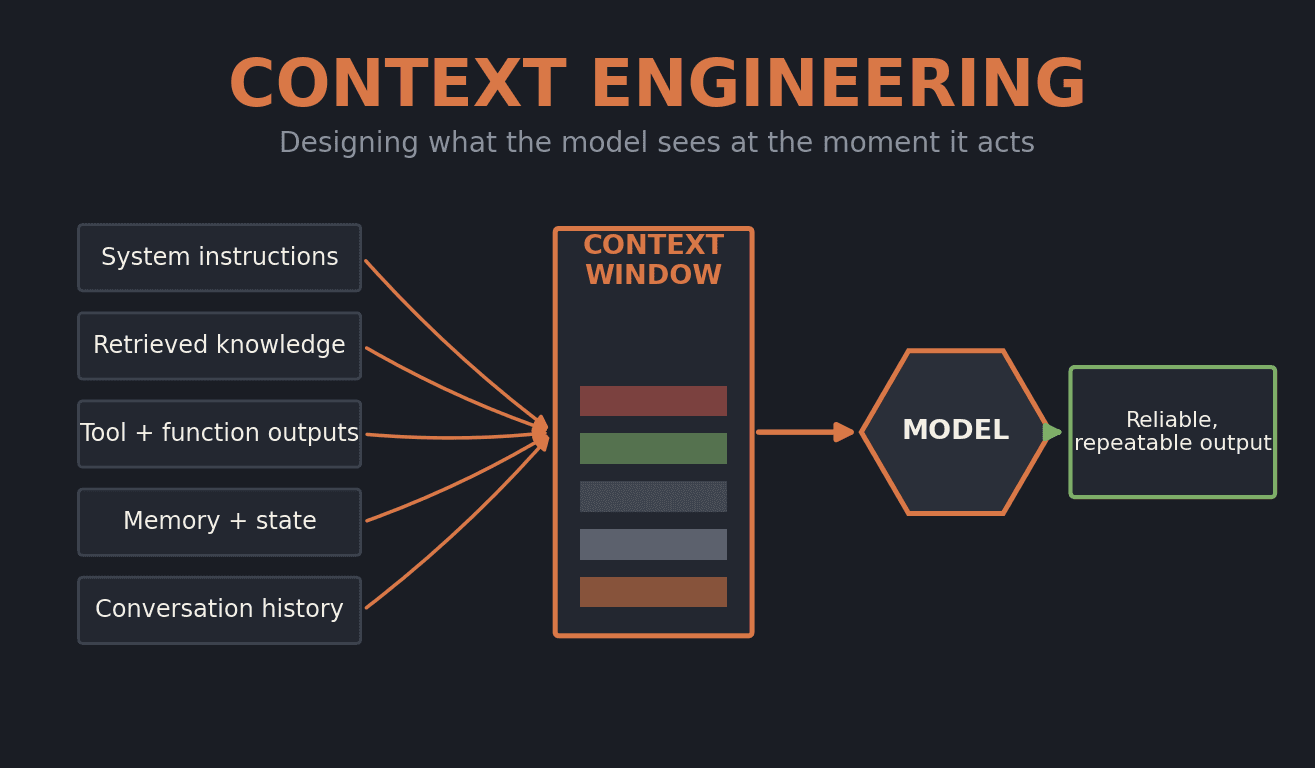
For two years the industry told everyone the same thing: learn to write better prompts. Prompt engineering became a job title, a course category, a badge on a profile. It was also, mostly, a distraction. The agentic systems that fail in production do not fail because someone phrased the instruction poorly. They fail because the model could not see the right things at the moment it had to act. That is a context problem, and context is an engineering discipline your delivery organization already knows how to run. It just has not put it on the org chart yet.
The teams pulling ahead with agentic AI have quietly stopped obsessing over the perfect prompt. They have started treating the entire context window as a product surface with owners, tests, and a release process. That shift has a name now, and it is the most important skill your delivery teams are not yet measuring.
Prompt engineering was the tutorial. Context engineering is the job.
Anthropic describes context engineering as the natural progression of prompt engineering: the practice of curating and maintaining the optimal set of tokens the model sees during inference. The framing matters. A prompt is a single input. Context is everything the model has in front of it when it acts: the system instructions, retrieved knowledge, the outputs of the tools it called, its memory and state, the running conversation history, and the format and guardrails you impose on the answer.
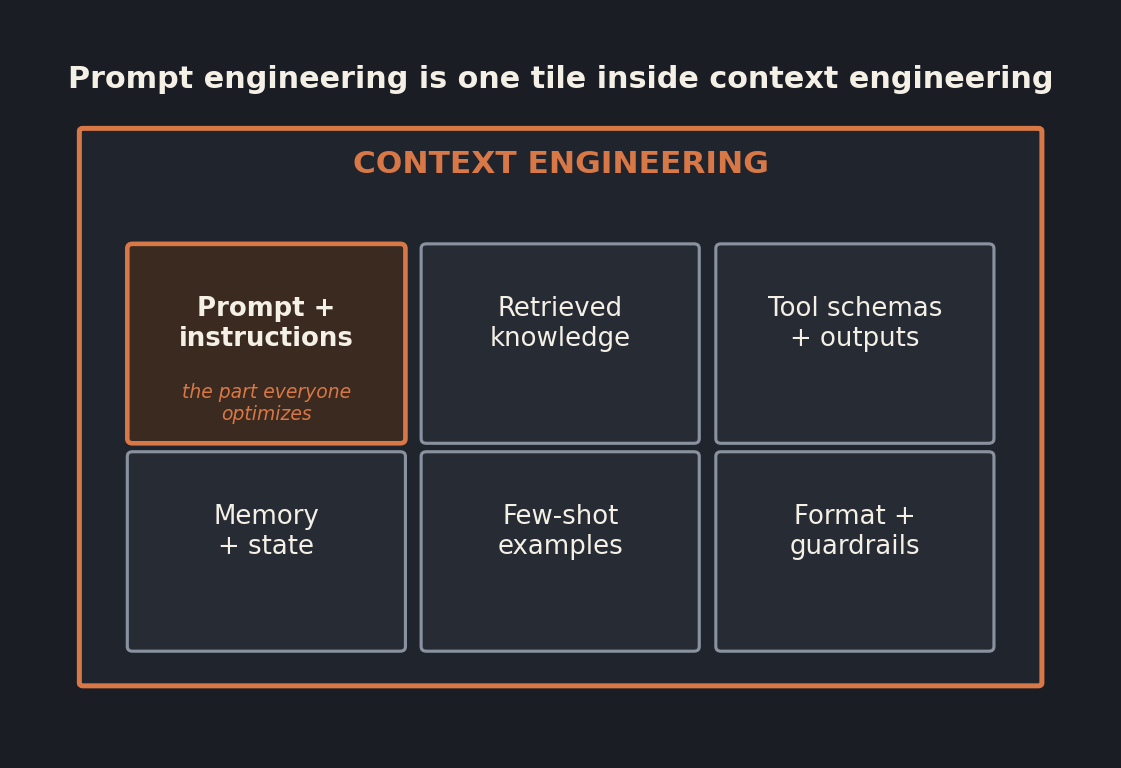
The prompt is the one tile everyone optimizes and the one that matters least inside a running agent. In a single-turn chatbot, the prompt is most of the context, so prompt wording feels decisive. In a multi-turn agent working a long task, the prompt is a rounding error next to the documents your retrieval layer injected, the JSON your tools returned, and the history that has been accumulating for forty steps. Optimize the wording all you like. If the retrieval pulled the wrong document, the agent is going to be confidently wrong, and no adjective in your system prompt will save it.
Why this is a delivery problem, not a research problem
Here is the reframe that changes how you staff and fund this work. Every component that assembles context is a system your delivery teams already build and ship. Retrieval pipelines. Vector indexes. Tool integrations. Memory stores. Prompt templates that live in a repository. These have owners, release cycles, regressions, and incidents, which is the exact vocabulary of delivery, not the vocabulary of a research lab.
When answer quality drops the morning after someone reindexed the knowledge base, that is a delivery regression with a commit attached to it, not a mysterious model mood. Retrieval is the highest-leverage and highest-risk part of the pipeline, which is why RAG belongs inside your delivery process rather than in an experimental notebook nobody owns. Memory is not a feature you bolt on at the end; it is context you deliberately curate and prune, a point I pushed hard in giving your AI agent a brain. The moment you accept that context is assembled by owned systems, the responsibility stops being "make the AI smarter" and becomes "govern what the AI can see." That is a job your delivery leaders can actually plan, staff, and hold a line on.
The context budget: attention is the scarcest resource
The seductive mistake is to treat the context window as free storage. It is not. Every token you add competes with every other token for the model's attention, and attention degrades long before the window fills. This is not folklore. In the widely cited Lost in the Middle study, researchers showed that models retrieve information most reliably when it sits near the beginning or the end of the input and measurably worse when the relevant fact is buried in the middle, even on models explicitly built for long context.
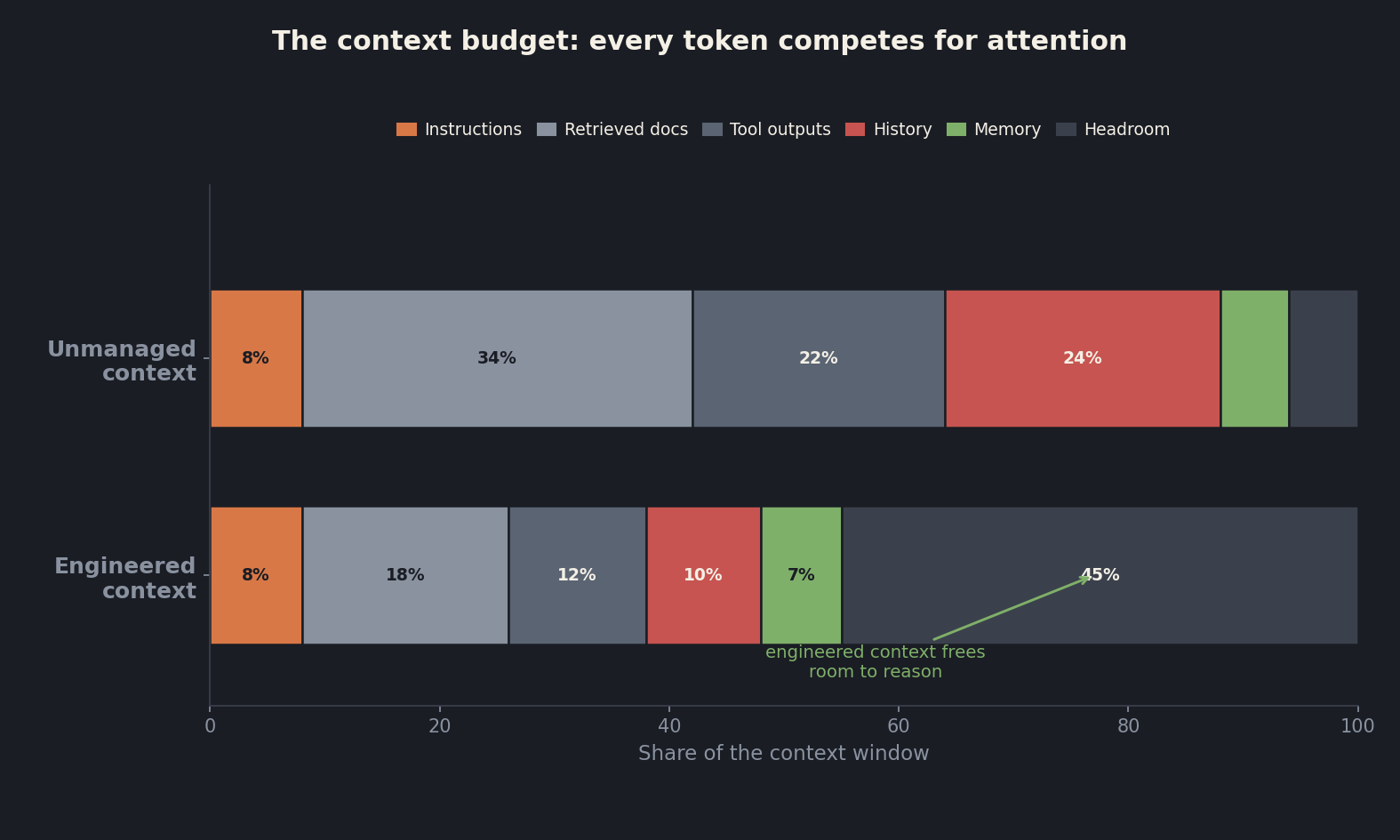
Read the chart as a budget, because that is what it is. In the unmanaged case, retrieved documents and raw history eat most of the window, tool outputs pile on top, and there is almost no headroom left for the model to actually reason. In the engineered case, each source is trimmed to what earns its place, and nearly half the budget stays open. More context is not more capability. Past a threshold it is more noise, more latency, and a bigger bill, all at once. The token cost is real and it compounds, but the quieter tax is the accuracy you lose when the signal drowns.
The failure modes hiding in your agents
Once you look at agents through a context lens, the recurring production failures stop looking random and start looking like a short, predictable list.
Retrieval that pulls the wrong thing
Your agent is only as good as the top few chunks your retriever returns. Stale embeddings, a bad chunking strategy, or a query that does not match how the source was written, and the model reasons beautifully over the wrong material. Retrieval quality is the single largest lever on agent accuracy, and almost nobody puts a metric on it.
Tool outputs that flood the window
A tool returns a 900-line API response and you paste all of it back into context. The model now spends its attention parsing scaffolding instead of solving the problem. Summarize, filter, and shape tool outputs before they re-enter the window. The tool result is raw material, not a finished ingredient.
Memory that never forgets
An agent that appends every interaction to memory does not get wiser, it gets slower and more distractible. Memory without a forgetting policy is just history sprawl wearing a nicer label. Decide what is worth remembering, for how long, and at what fidelity.
History that never compacts
Long-running sessions accumulate turns until the earliest and most important instructions fall into the low-attention middle of the window. Compaction, summarizing prior turns into a dense running state, is not an optimization you do later. It is core to keeping an agent coherent past the first dozen steps.
An operating model for context
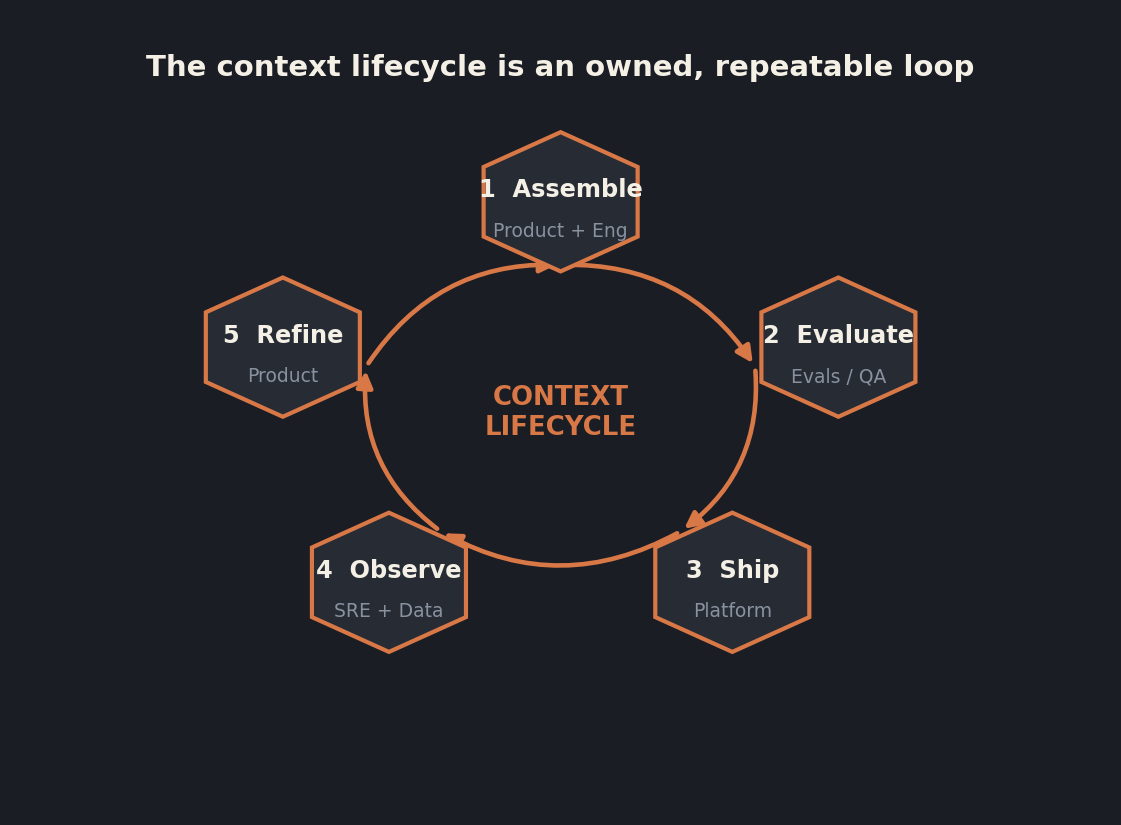
None of this is exotic. It is the ordinary delivery loop applied to a new surface. Treat context as something you assemble, evaluate, ship, observe, and refine, with a clear owner at each stage.
Put context under version control
Prompt templates, retrieval configurations, tool schemas, and memory policies are artifacts. They belong in a repository with diffs, reviews, and rollbacks, not pasted into a console and forgotten. If you cannot answer "what changed in our context assembly last Tuesday," you cannot run this reliably.
Test context with evals, not vibes
You do not ship a retrieval change because it looked better in one demo. You ship it because a suite of graded cases held or improved. This is the same argument I made in evals are the new acceptance criteria: the eval set is your regression net, and context changes are exactly the kind of silent regression that net exists to catch.
Observe context in production
Log what actually went into the window: which chunks were retrieved, how many tokens each source consumed, where the budget went. You cannot debug an agent whose context you cannot see after the fact. The teams who instrument this find their worst failures are boring and fixable, a bad retriever or an un-compacted history, rather than some deep flaw in the model.
What to do this quarter
Start by naming an owner. Context assembly that belongs to everyone belongs to no one, and it will rot. Instrument your context next, so you can see token allocation per source in production before you try to optimize anything. Then put a number on retrieval quality and wire it into your eval suite, because it is the highest-leverage lever you have. Set explicit policies for memory retention and history compaction so your long sessions do not quietly degrade. And move your prompts, retrieval configs, and tool schemas into version control if they are not already there.
Prompt engineering taught a generation of teams that words matter. Context engineering is the harder, more valuable lesson: that what the model can see, at the instant it decides, is a system you own and are accountable for. The organizations that internalize this will ship agents that hold up under real load. The ones still hunting for the magic prompt will keep wondering why their impressive demo falls apart the moment it meets production.
References
- Anthropic. Effective context engineering for AI agents. anthropic.com
- Liu, Nelson F. et al. Lost in the Middle: How Language Models Use Long Contexts. arxiv.org