
Environment Provisioning Is the Agentic Delivery Bottleneck Nobody Budgeted For
Agents made writing code cheap, but proving it still needs somewhere to run. Environment provisioning and test data have quietly become the binding constraint on agentic delivery. Here is why shared pre-prod collapses under parallel agents, plus the environment tiers, test data strategy, and metrics that fix it.
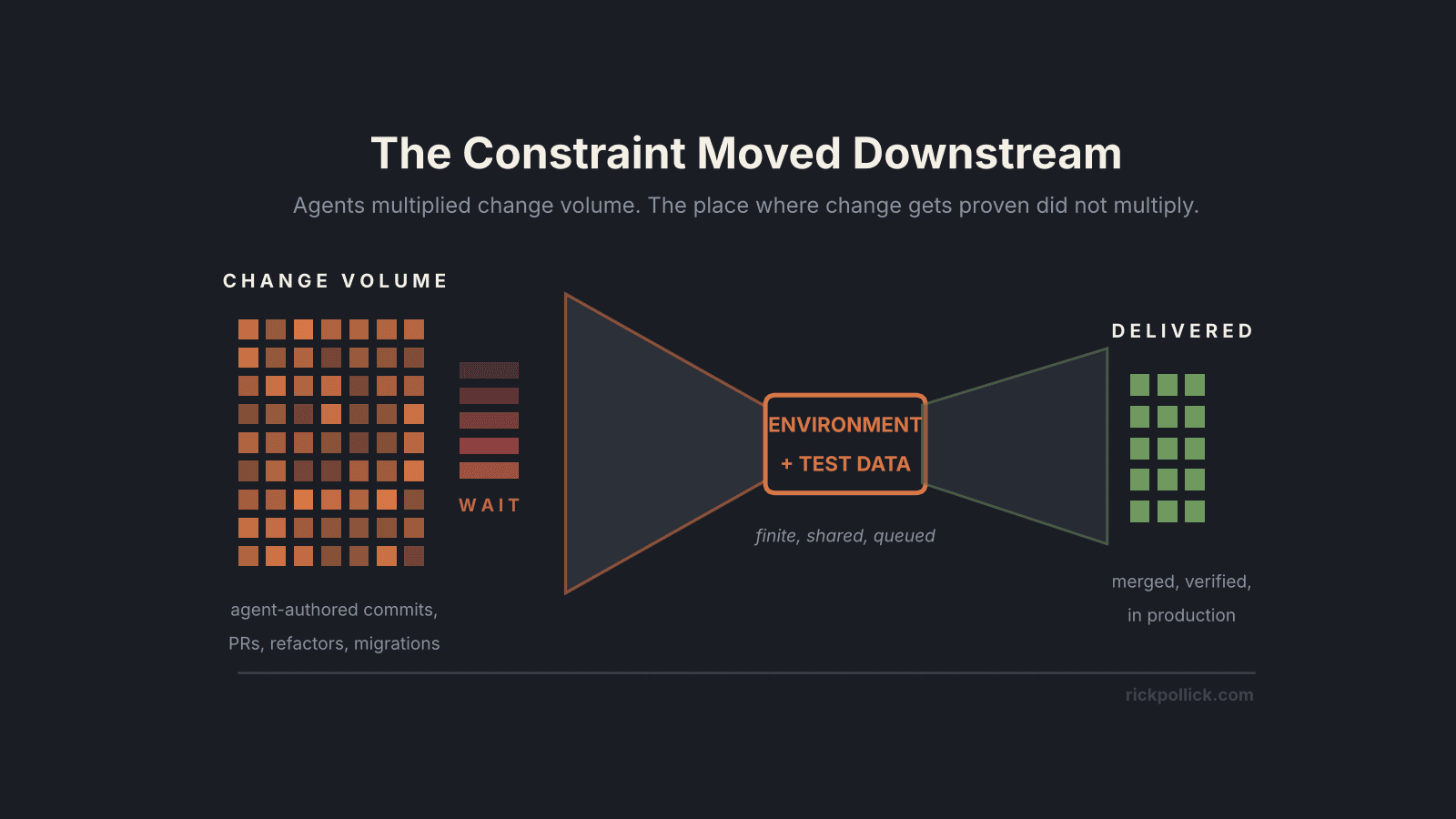
Your agents are not slow. Your pipeline is not slow. The thing quietly eating your delivery gains is the least glamorous line item in the platform budget: the place where a change gets proven before it ships.
For three years the conversation about AI in delivery has been about output. Agents write more code, open more pull requests, and close more tickets than any team could manage a few years ago. Leaders watched throughput climb, then watched lead time refuse to follow. The gap between those two lines is almost always a queue, and far more often than anyone plans for, it is a queue for an environment.
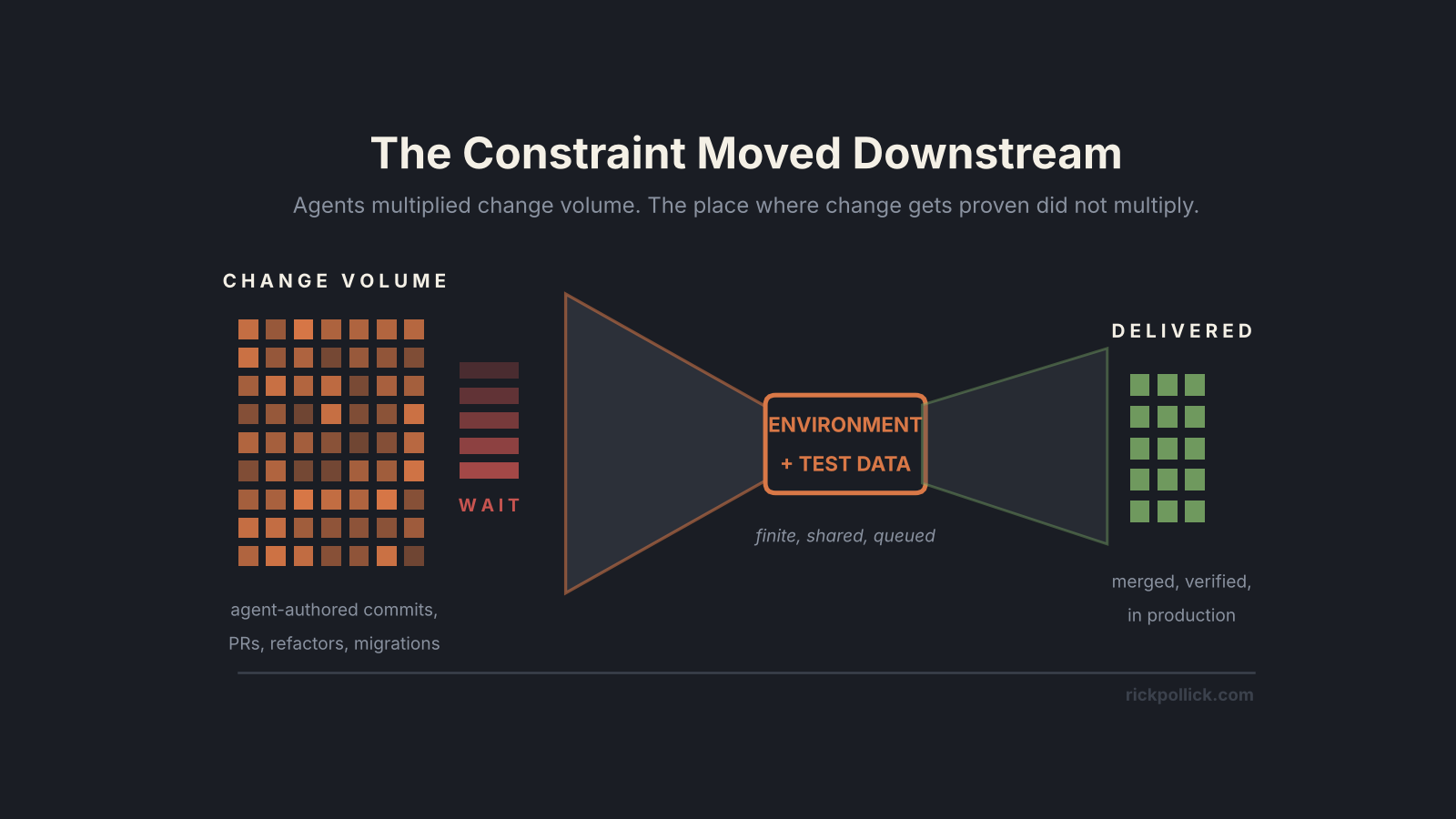
The Constraint Keeps Moving, and It Just Landed Somewhere Unfashionable
Every delivery system has exactly one binding constraint at a time. Fix it and the constraint does not disappear, it relocates.
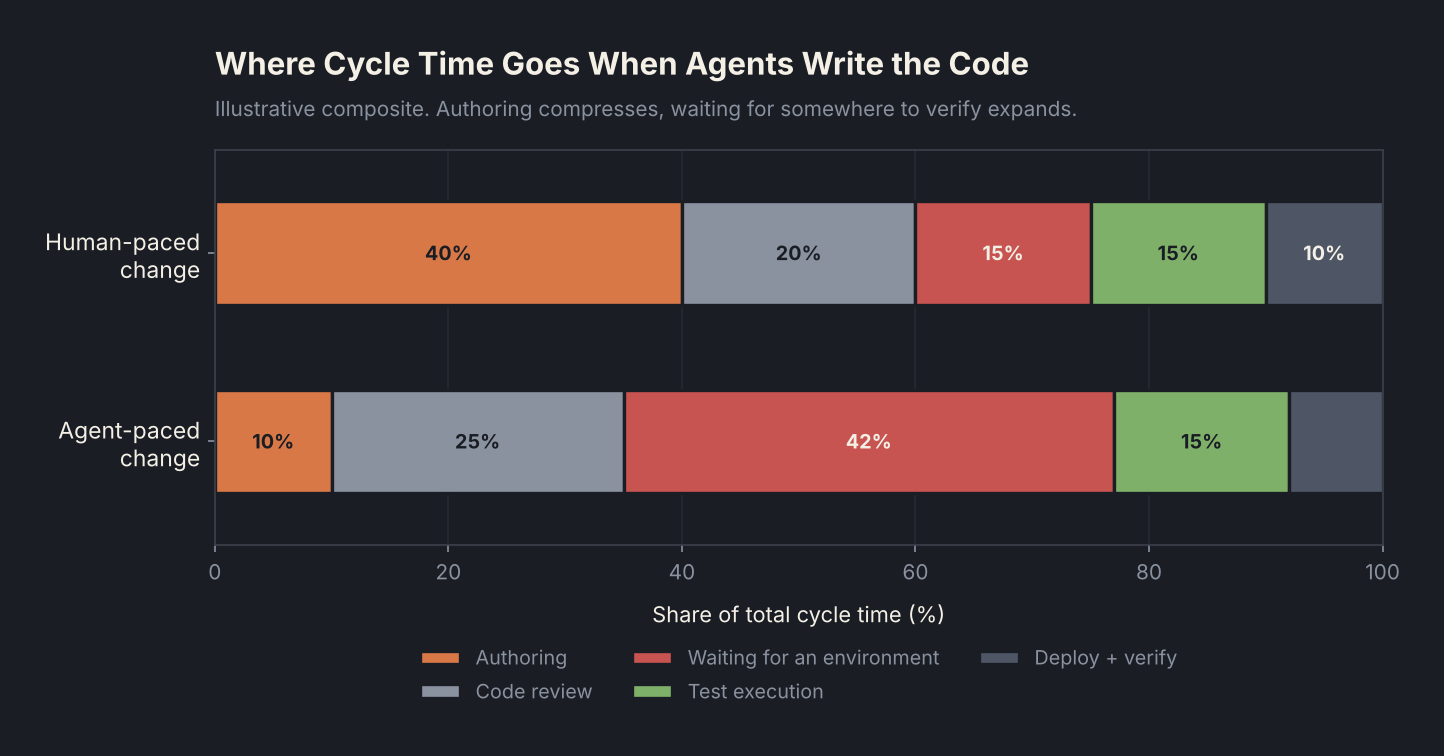
For most of the last decade the constraint was authoring. Writing the code was the slow part, so we hired engineers, bought copilots, and optimized for lines shipped. Agents demolished that constraint. The next wall was review, which is why review capacity became the new delivery ceiling for teams whose agents outpaced their humans. Teams that attacked review with smaller batches, better context, and a merge queue on the critical path got through that wall too.
Then they hit the next one, and this one does not yield to process improvement. It yields to infrastructure.
Google's DORA research is blunt about the tradeoff: higher AI adoption correlates with increased throughput and increased instability at the same time. Roughly 90 percent of technology professionals now report using AI at work, and about 30 percent report little or no trust in the code it produces. That low trust number is not an attitude problem to be managed away with training. Distrust is a verification requirement wearing different clothes. Every unit of distrust converts directly into demand for evidence, and evidence requires a running system with realistic data in it.
So the agent drafts the change in four minutes, and then the change waits six hours for somewhere to be proven. That is not an AI problem. That is a capacity planning failure with an AI-shaped trigger.
The Survey Data Said This Before Agents Made It Worse
This is not a new weakness. Agents just removed the slack that was hiding it.
Rafay Systems surveyed more than 500 platform teams and application developers about environment provisioning. The findings are a catalog of a system already at its limit: 61 percent called environment provisioning a major roadblock to accelerating application deployment, 57 percent said they have to wait on another team or a ticketing system, and 41 percent said rolling out environments simply takes too long. Meanwhile 94 percent of platform teams and 89 percent of developers said they want self-service provisioning.
Read those numbers again with the date in mind. That is the human-paced baseline, measured when demand was generated by people typing. Now multiply the arrival rate by an agent fleet and keep the service capacity flat.
The platform engineering data points the same direction from the other side. Octopus Deploy's 2026 Future of Platform Engineering report, built on responses from 379 platform practitioners, found that teams whose platforms offered advanced capabilities, ephemeral environments among them, reported positive AI effects on both delivery speed and stability. Teams without those capabilities did not get the same result from the same tools.
That is the whole thesis in one finding. DORA describes AI as an amplifier of existing system quality. The environment layer is a very large share of what "existing system quality" actually means in practice.
Why Shared Environments Collapse Under Parallel Agents
Here is the structural piece most delivery plans miss, and it is not a tooling gap. It is arithmetic.
Human engineers serialize themselves. People take meetings, context switch, go to lunch, and think before they push. That natural raggedness keeps demand on shared environments well below saturation, which is why a single staging environment served a team of twelve for years without anyone filing a complaint.
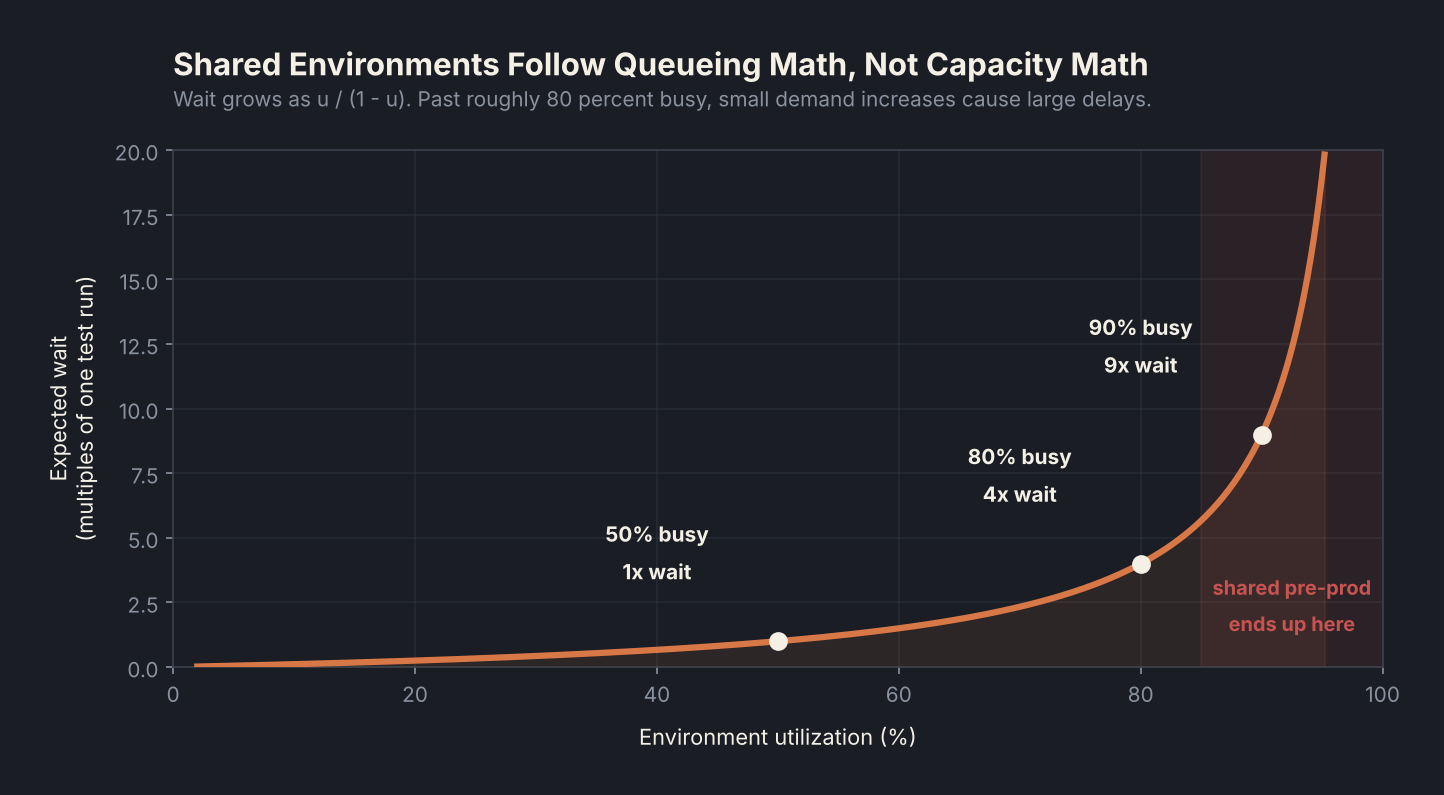
An agent fleet does not serialize itself. Five agents working five tickets will all reach the verification step at roughly the same time, repeatedly, all day, with no lunch break to smooth the curve. Demand on the shared environment stops looking like a trickle and starts looking like a load test.
Queueing behavior is unforgiving here. Wait time scales with utilization as u divided by (1 minus u), which means the pain is not linear and the warning signs arrive late. At 50 percent utilization the expected wait is roughly one test run. At 80 percent it is four. At 90 percent it is nine. A shared pre-prod environment that felt comfortable last quarter can become a multi-hour queue this quarter without anyone changing a single configuration file. Nothing broke. The arrival rate changed.
There is a second-order effect that does more damage than the waiting itself. When environments are contended, rational engineers batch their changes to amortize the wait. Batch size grows, blast radius grows with it, and failure diagnosis gets harder because three changes went in together. Every instinct that progressive delivery depends on gets inverted by a queue. Contention does not just slow you down, it quietly makes your releases more dangerous.
It is also worth naming what a shared integration environment actually is in architectural terms: a mutable global variable with a Slack channel attached. We would reject that design in code review. We tolerate it in infrastructure because it used to be cheap enough to tolerate.
Test Data Is the Hard Half
Most teams that decide to fix this go after compute first, because compute is the part with vendors and demos. Containers, infrastructure as code, and preview environments are a largely solved commercial problem now. You can buy your way to a running stack per pull request.
You cannot buy your way to the data, and the data is what determines whether the verification means anything.
Four constraints collide in test data, and they pull against each other:
- Privacy and regulation. Production data carries real obligations. Copying it into forty ephemeral environments multiplies your exposure surface by forty.
- Referential integrity. In a service-oriented estate, a customer record in one service references entities in six others. Subsetting without breaking those relationships is genuinely hard engineering.
- Volume realism. A seeded database with 200 rows will never surface the query that falls over at two million. Agents are particularly good at writing code that is correct and catastrophically slow.
- Freshness. Data that mirrored production nine months ago no longer resembles production. Schema drifts, distributions shift, and your tests slowly start validating a system that does not exist.
No single strategy satisfies all four. Full production clones give you fidelity and hand you a compliance liability plus provisioning times measured in hours. Synthetic generation is fast, safe, and misses the ugly edge cases that real data contains. Masked subsets sit in the middle and cost real engineering effort to maintain. Hand-built fixtures are instant and shallow.
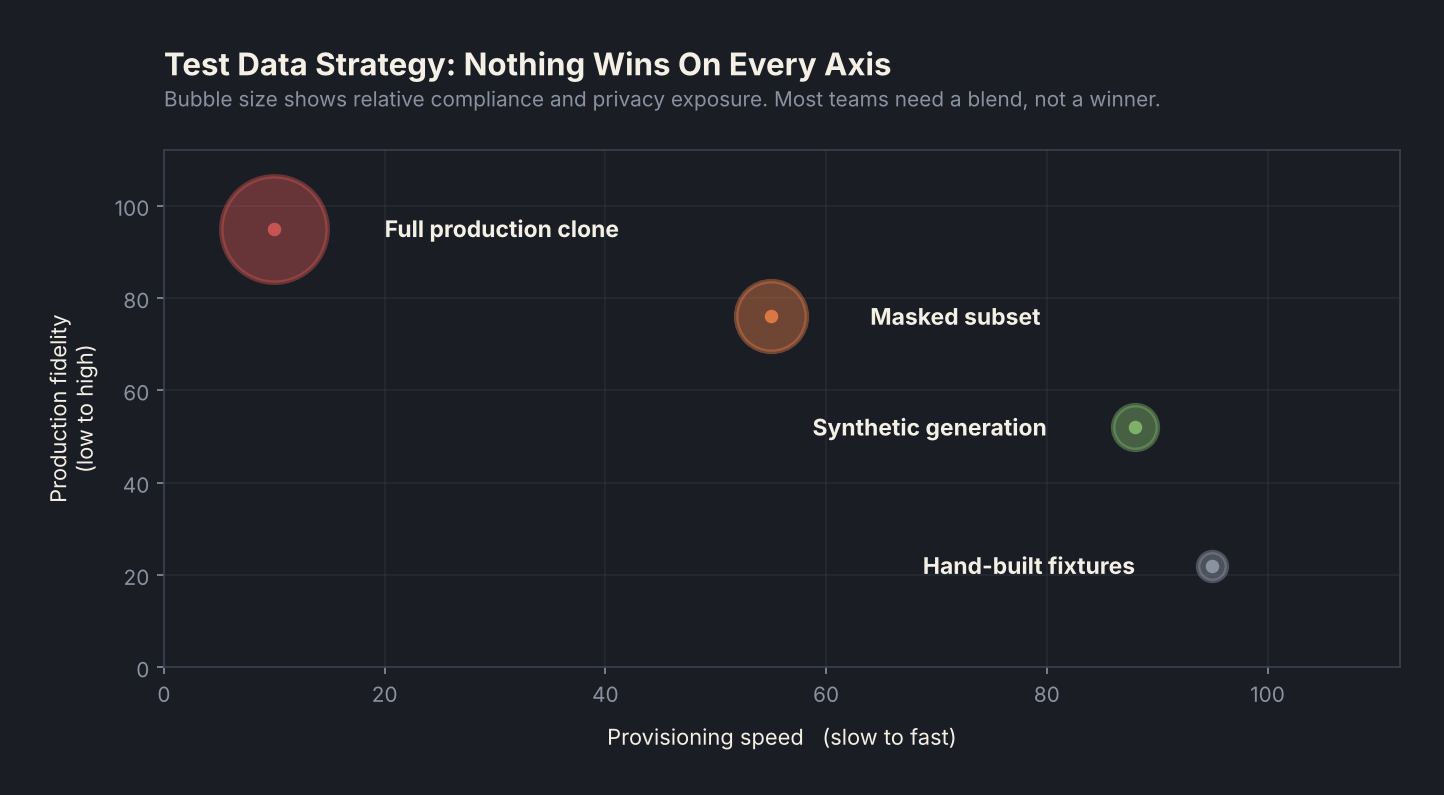
The answer is not to pick a winner. It is to match the data strategy to the environment tier, and to stop pretending one dataset serves every purpose.
A Four Tier Model That Survives an Agent Fleet
The governing principle is simple: use the cheapest environment that can falsify the change. Most teams invert this and send everything to the most expensive tier because that is where the trustworthy data lives.
Tier 1, the agent sandbox. Created per task, alive for minutes, built from fixtures and synthetic data with external dependencies mocked or contract-stubbed. This is where an agent runs unit tests, linting, and type checks. It must provision in seconds and cost close to nothing, because it will be created thousands of times a month. No queue is acceptable here.
Tier 2, the ephemeral preview. One per change or pull request, alive for the life of the branch, running the real service against a masked data subset and real versions of its closest dependencies. This is where the majority of integration confidence should be earned. It is also where the economics get interesting, which is why this tier is the one worth over-provisioning.
Tier 3, scheduled integration. Shared, but booked rather than contended. Cross-service contract verification, migration rehearsal, and anything genuinely requiring the full estate. Make the booking explicit and visible so the queue is a managed resource rather than an unpleasant surprise.
Tier 4, protected pre-production. High fidelity, tightly controlled, with real volume and performance characteristics. Deliberately scarce. Reserved for release candidates and performance validation, not for routine change verification.
Production remains production, protected by progressive delivery and an error budget rather than by hope.
If most of your verification currently happens in tiers 3 and 4, your agents are queueing for a resource that was never designed to be hit at that rate, and no amount of pipeline tuning will fix it.
The Metrics That Expose This
You cannot argue for this budget with anecdotes. Instrument it:
- Time to environment, p50 and p95, from request to usable. If p95 is measured in hours, you have found your constraint.
- Environment wait ratio: time waiting for an environment divided by total cycle time. Under 15 percent is healthy. Over 35 percent means you are paying for agent capacity you cannot land.
- Provisioning success rate. A preview environment that fails to come up 20 percent of the time is worse than no preview environment, because it teaches engineers to skip the tier entirely.
- Data freshness lag, in days, between production schema and test data schema.
- Environment cost per merged change. The honest denominator. This belongs in the same conversation as FinOps for AI, because both are about making engineering consumption legible to finance before finance makes it legible to you.
Notice that none of these appear in the standard four DORA metrics, which is part of why this constraint stays invisible for so long. Deployment frequency and lead time tell you something is wrong. They do not tell you it is the environment layer, which is one more reason the classic metrics need supplementing in the agentic era.
What This Means for Your Program Plan
For anyone running a delivery program rather than a single team, the practical shift is this: environment capacity is a dependency with lead time, and it belongs on the critical path.
Most program plans model people, scope, and sequence. Very few model verification concurrency. When you plan an agentic workstream, the question is no longer only "how many engineers and agents will we have" but "how many changes can we verify in parallel on day one, and what is the lead time to raise that number." Provisioning capacity, data masking pipelines, and environment tooling all have build times measured in weeks. Discovering that in month three of a program is the expensive way to learn it.
Three concrete actions:
- Add environment concurrency to the dependency map alongside your other hard constraints, and treat saturation as a schedule risk with a named owner. This is exactly the kind of signal that dependency density surfaces better than a classic critical path view.
- Write an architecture decision record for the environment tier model and the data strategy per tier. Agents work from written context, and an undocumented environment policy will be ignored by humans and agents alike.
- Put a line in the budget. Ephemeral environments and data pipelines cost real money, and the comparison is not against zero.
The Trade Nobody Wants to Name
That last point deserves honesty, because the cost objection is the one that kills these initiatives.
Ephemeral environments are not free. Spinning up a preview stack per pull request across a large estate is a visible, recurring infrastructure bill, and it will show up on a dashboard that someone is accountable for.
Set it against the alternative. The first alternative is idle agent capacity and delayed releases, which is a real cost that simply does not appear on an infrastructure invoice. The second alternative is worse and more common: teams skip verification because verification is inconvenient, and the shortfall surfaces later as instability. DORA's own ROI modeling shows change failure rate rising after AI adoption, with the resulting downtime wiping out a meaningful share of the productivity gain. You can pay for environments, or you can pay for incidents. Only one of those is predictable.
The agent does not need to be smarter. It needs somewhere to fail, quickly, repeatedly, cheaply, against data that looks enough like production to tell the truth. Build that layer and the throughput you have already paid for finally reaches customers. Skip it and you will keep buying faster authoring for a system that cannot verify what it writes.
References
- Google DORA. Balancing AI Tensions: 2025 State of AI-assisted Software Development. dora.dev
- Octopus Deploy. The Future of Platform Engineering Report. octopus.com
- DevOps Digest. Developer Experience Gap in Environment Provisioning is Delaying Deployment of Modern Apps. devopsdigest.com