
Give Your AI Agent a Brain: The Contextual Proxy Pattern for Targeted Context
Most AI agents fail not because the model is bad, but because the agent shows up every morning with no memory, no voice, no priorities, and no idea what your week looks like. A targeted "brain" fixes that. The contextual proxy pattern, the six components, the five-phase loop, the multi-repo and multi-target patterns, the four cadences that grow the "brain" over time, the layered guardrail model, a seven-step getting-started guide, ROI math, and the three failure modes that quietly kill the discipline.
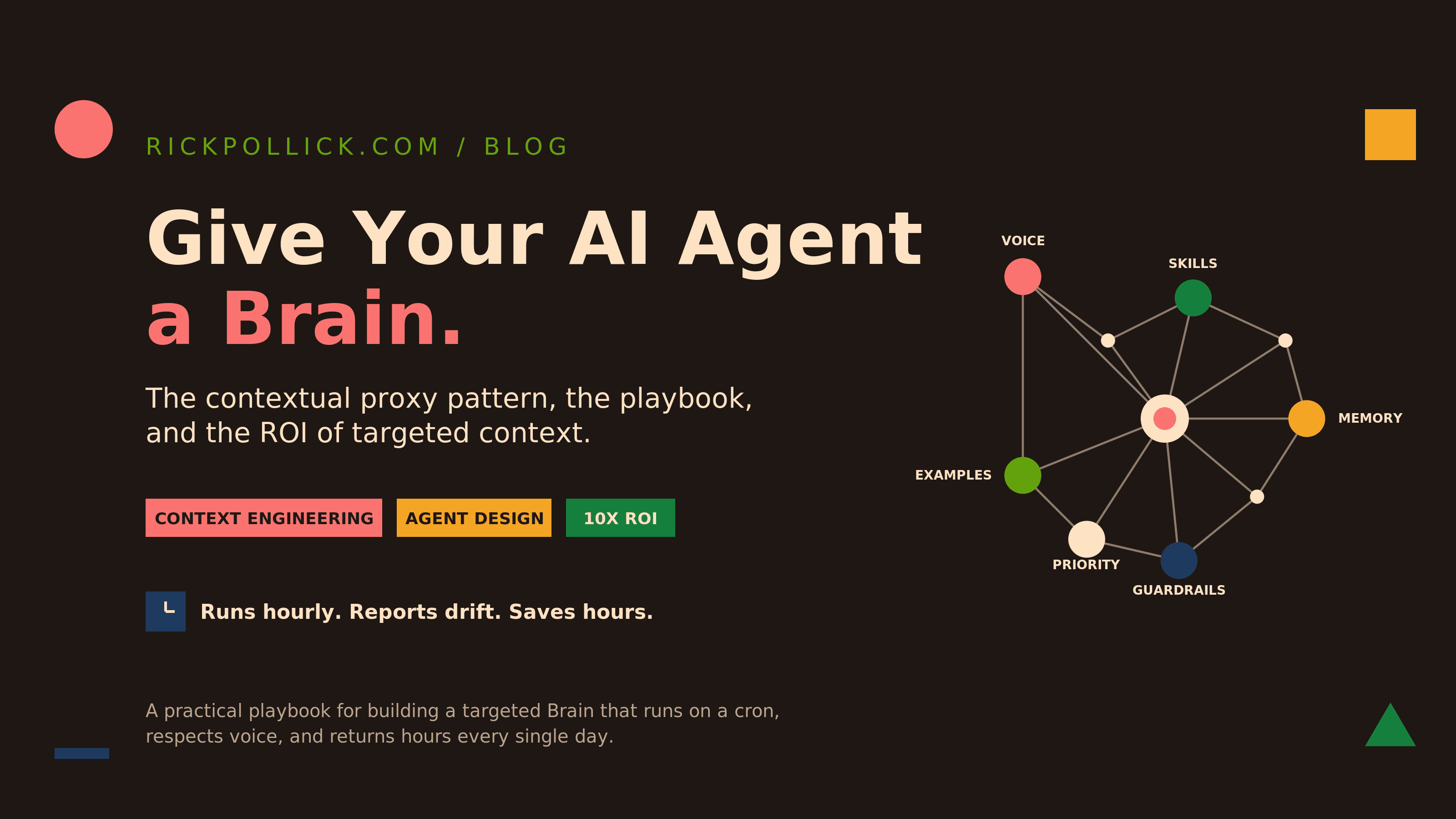
The first time I built a contextual AI proxy for a real working week, I did it wrong. I gave the agent a clever prompt, hooked it up to a few connectors, set a cron, and watched it produce twenty-seven beautiful, generic, useless briefings in a row. Each one had the cadence of a McKinsey deck and the substance of a fortune cookie. None of it sounded like me. None of it knew what I was actually working on. The thing was tireless and confidently wrong.
The fix was not a better model. It was a "brain".
Members only
Keep reading for $2 / month.
The rest of this essay — along with every other members-only post, playbook, and working note — is behind a small paywall. Cancel anytime.
Payment handled by Stripe. Card details never touch this site.