The Gentle Singularity: What Sam Altman's AGI Declaration Actually Means for Enterprise Leaders
Sam Altman declared we have crossed the event horizon into the singularity. Dario Amodei expects Nobel-caliber AI by 2027. $690 billion in AI infrastructure spending is committed for 2026 alone. Here is what the AGI declarations, the rhetoric shifts, and the capital flows actually mean for leaders building products and running delivery programs right now.
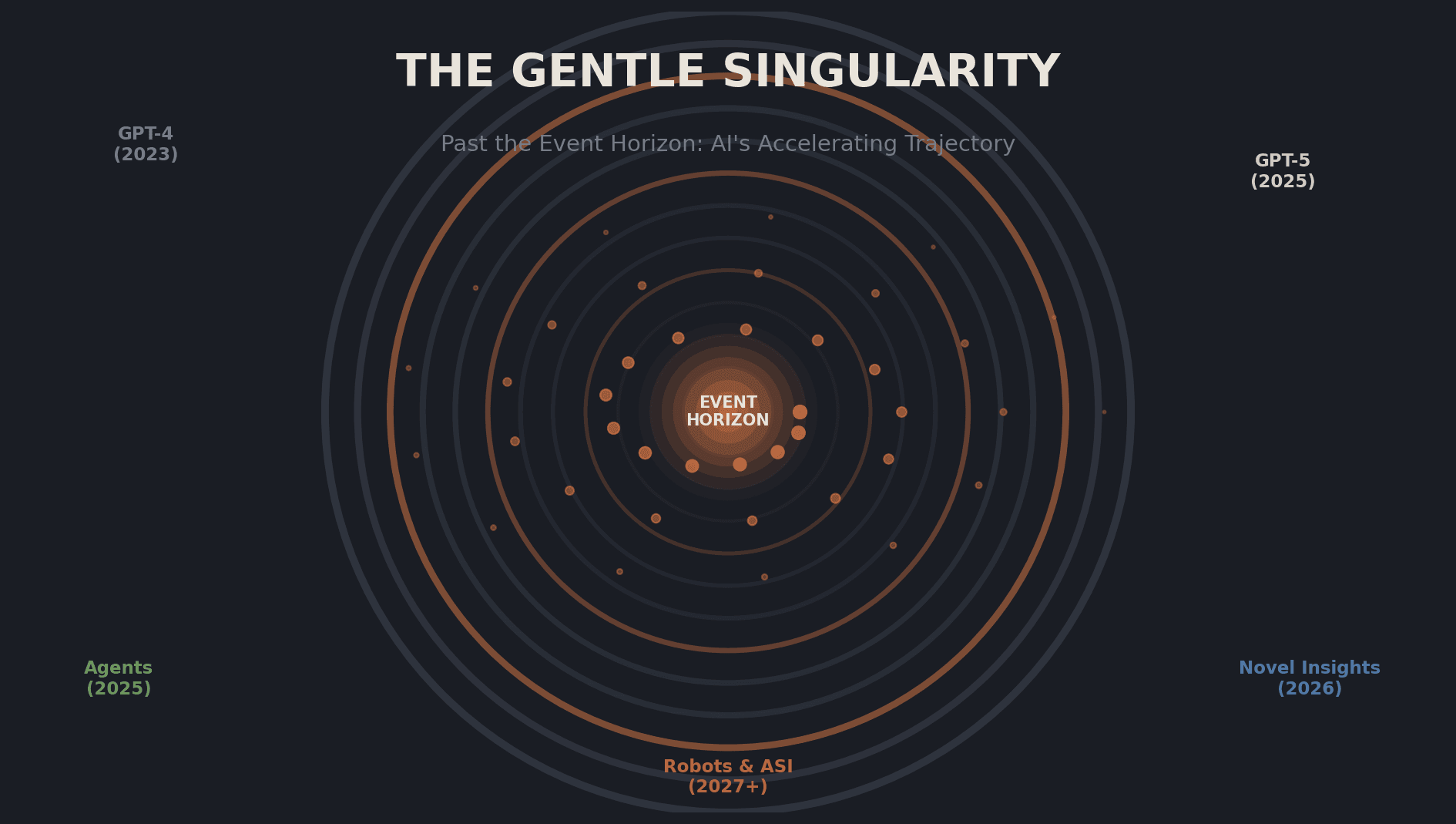
On June 10, 2025, Sam Altman published a 2,200-word essay that quietly declared the most consequential technological threshold in human history had already been crossed. No press conference. No product launch. Just a blog post titled "The Gentle Singularity" on his personal Posthaven page, stating in its very first line: "We are past the event horizon; the takeoff has started."
That sentence landed like a depth charge in the AI community. Within days, Forbes analysts were dissecting it, AI ethicists were rejecting it, crypto markets were reacting to it, and enterprise leaders were asking the only question that actually matters: what does this mean for what we are building right now?
Thirteen months later, we have enough data to move past the initial reactions and evaluate the claim on its merits, against the evidence, and through the lens of what it means for the people who actually ship products and run delivery programs. That is the conversation I want to have.
What Altman Actually Said
The essay is worth reading in full, but here are the claims that matter most, quoted directly.
The headline claim: "We are past the event horizon; the takeoff has started. Humanity is close to building digital superintelligence, and at least so far it's much less weird than it seems like it should be."
The capability timeline: "2025 has seen the arrival of agents that can do real cognitive work; writing computer code will never be the same. 2026 will likely see the arrival of systems that can figure out novel insights. 2027 may see the arrival of robots that can do tasks in the real world."
The economic thesis: "In the 2030s, intelligence and energy, ideas, and the ability to make ideas happen, are going to become wildly abundant. These two have been the fundamental limiters on human progress for a long time; with abundant intelligence and energy (and good governance), we can theoretically have anything else."
The recursive improvement argument: "From here on, the tools we have already built will help us find further scientific insights and aid us in creating better AI systems. Of course this isn't the same thing as an AI system completely autonomously updating its own code, but nevertheless this is a larval version of recursive self-improvement."
The convergence prediction: "As datacenter production gets automated, the cost of intelligence should eventually converge to near the cost of electricity."
And the sign-off that reads like a prayer: "May we scale smoothly, exponentially and uneventfully through superintelligence."
That is a staggering amount of ground to cover in a blog post. Let's unpack it.
The Rhetoric Shift That Nobody Should Ignore
Before evaluating the substance of the claims, it is worth tracking the trajectory of the person making them. Sam Altman's public rhetoric on AI has undergone a transformation so dramatic that it deserves its own analysis.
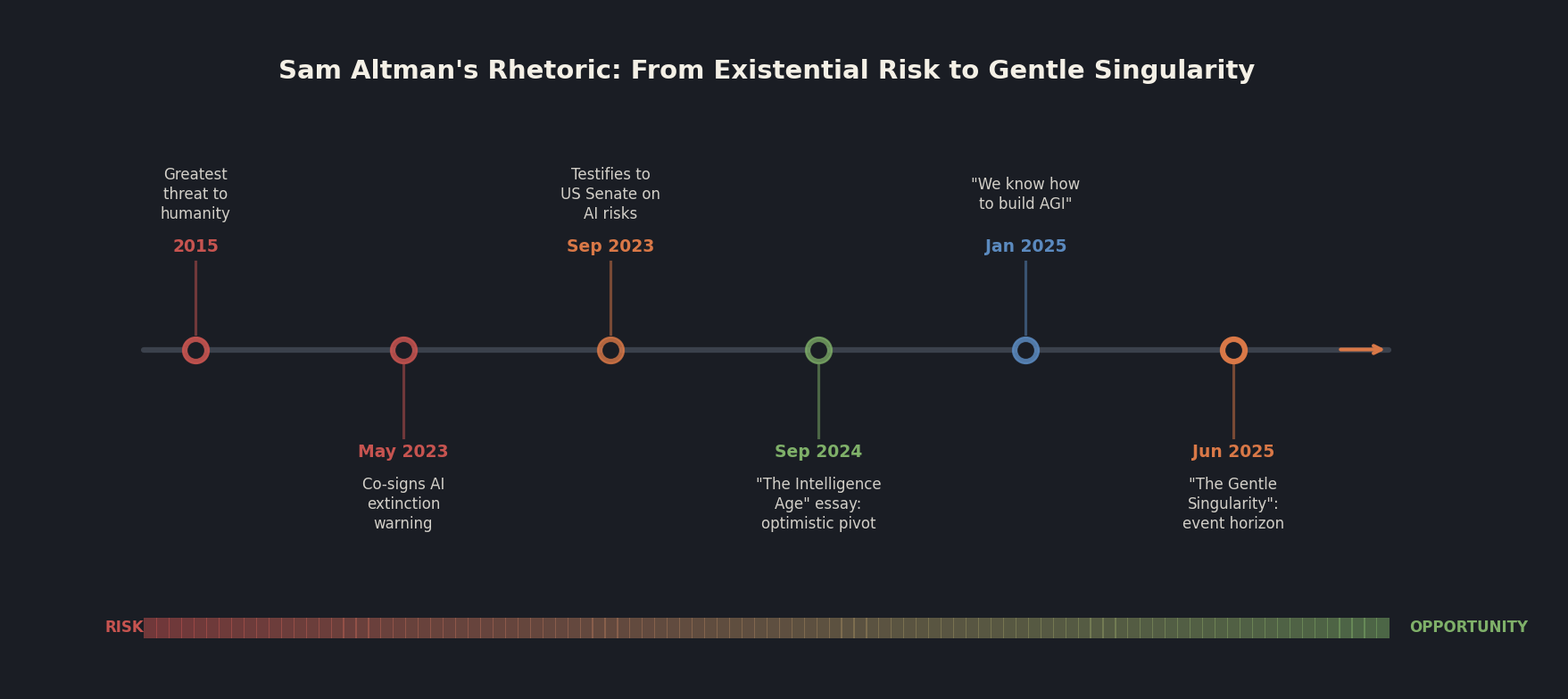
In 2015, Altman wrote on his blog that "development of superhuman machine intelligence is probably the greatest threat to the continued existence of humanity." In May 2023, he co-signed a statement alongside hundreds of AI researchers that read: "Mitigating the risk of extinction from AI should be a global priority alongside other societal-scale risks such as pandemics and nuclear war." That same year, he testified before the U.S. Senate, advocating for regulation of the very technology his company was building.
Then the tone changed. In September 2024, his essay "The Intelligence Age" struck a markedly more optimistic note. By January 2025, he wrote: "We are now confident we know how to build AGI as we have traditionally understood it." And by June 2025, the existential threat had become a "gentle singularity," a transition described as "gradual and manageable" rather than catastrophic.
The shift from "greatest threat to humanity" to "gentle singularity" took roughly a decade. The most charitable interpretation is that Altman genuinely updated his beliefs as evidence accumulated. The less charitable interpretation, offered by multiple analysts, is that the rhetoric is strategic: as OpenAI has grown from a research lab into a company reportedly valued north of $300 billion, the incentive structure for how its CEO talks about AI has changed accordingly.
Both interpretations can be true simultaneously, and for enterprise leaders the lesson is the same: treat every industry prediction as a position statement, not a weather forecast. The people building the rockets have structural incentives to tell you liftoff is imminent.
The AGI Landscape: Where We Actually Stand
Altman is not alone in making aggressive claims. The AGI prediction landscape in mid-2026 looks like a high-stakes poker table where everyone is showing their cards simultaneously.
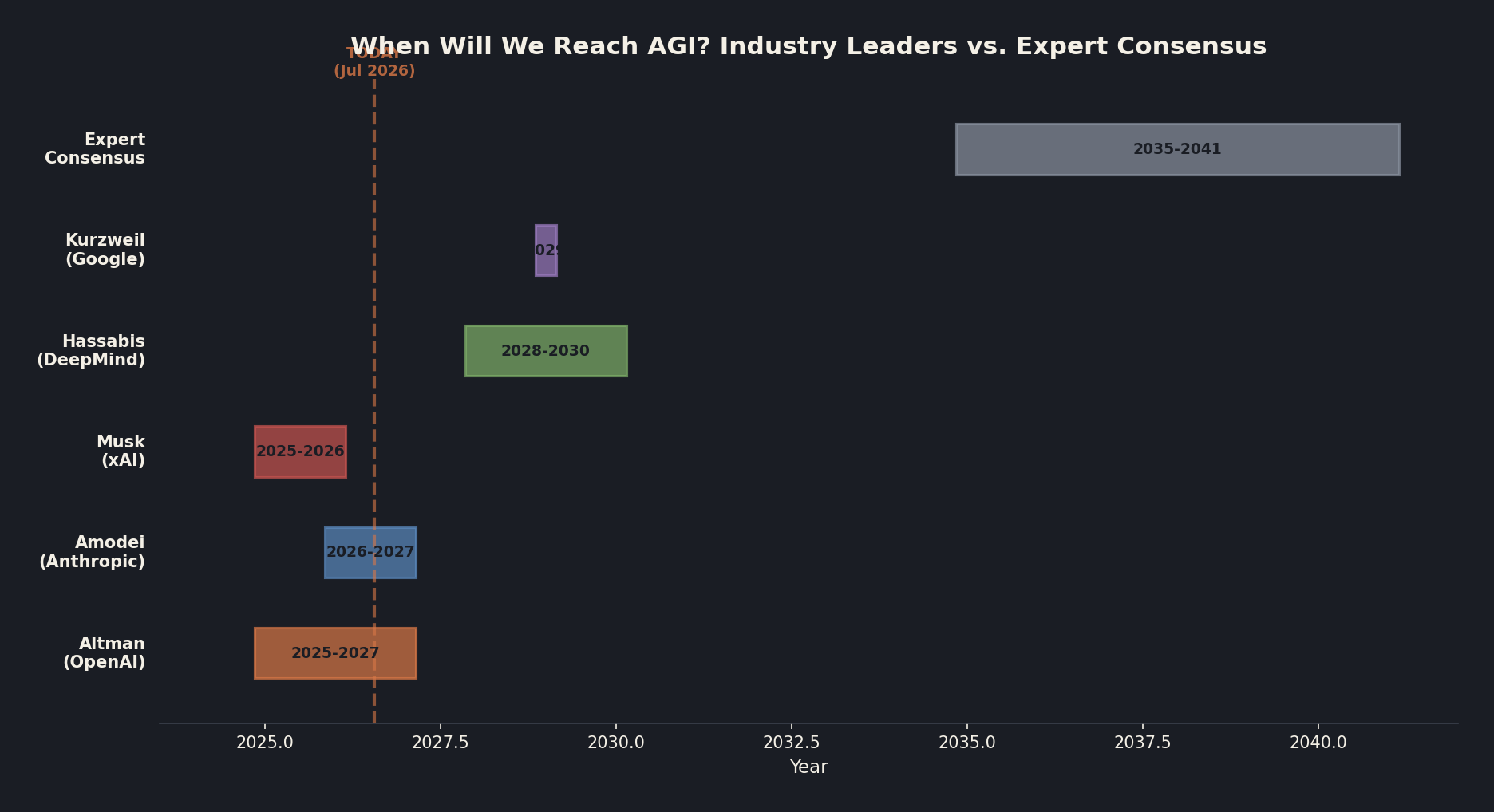
Dario Amodei, CEO of Anthropic, published his own 15,000-word essay in October 2024 titled "Machines of Loving Grace." His prediction: "We expect powerful AI systems will emerge in late 2026 or early 2027." Anthropic defines "powerful" as intellectual capabilities matching or exceeding Nobel Prize winners across most disciplines. As of early 2026, Amodei stated: "My guess is that we'll get that in 2026 or 2027."
Elon Musk has predicted AGI arriving around 2025-2026, though his track record on predictions (from self-driving Teslas to Mars colonies) invites healthy skepticism.
Demis Hassabis, founder of Google DeepMind, has been more cautious, maintaining a 50% chance of achieving AGI by 2030.
Ray Kurzweil, who has been predicting the singularity longer than most of these companies have existed, has long targeted 2029 for human-level machine intelligence and 2045 for the full singularity.
And then there is the broader expert community, which tells a very different story. Current prediction markets and academic surveys indicate only a 10% probability of achieving AGI in 2026, with the 50% probability point sitting around 2041. That is a massive gap between what the people building AI are saying and what the wider field believes.
The gap matters. When the people with the most to gain financially are the most aggressive in their predictions, and the people with the least financial stake are the most conservative, that pattern should inform how you weight the claims.
The Evidence: What Has Actually Changed
Setting aside the rhetoric, something genuinely remarkable has happened in the last 18 months. The capabilities are real even if the framing is debatable.
GPT-5 launched in August 2025 as OpenAI's unification play, collapsing GPT-4o, o3, o4-mini, and GPT-4.5 into a single architecture. It hit 94.6% on AIME 2025 for mathematical reasoning and 74.9% on SWE-bench Verified for software engineering, and it hallucinates roughly 80% less than GPT-4o did. By March 2026, GPT-5.4 expanded the context window to one million tokens and introduced native computer-use capabilities, achieving 75.0% on OSWorld-Verified, which surpasses the human baseline of 72.4%.
DeepMind's Gemini achieved gold-medal performance at the 2025 International Mathematical Olympiad, marking a genuine milestone in AI's ability to reason through problems that stump most humans.
Anthropic's Claude has pushed the frontier on agentic coding, extended thinking, and computer use. The competitive dynamic across all three labs (and Meta, with its open-weight Llama models) is accelerating capability development at a pace that even insiders find surprising.
But here is the part of Altman's essay that resonated most with me: "We already hear from scientists that they are two or three times more productive than they were before AI." That claim aligns with what I am seeing in delivery programs across enterprises. The productivity amplification is real. Teams that have genuinely integrated AI into their workflows are shipping more, and I wrote about how review capacity, not generation, is becoming the actual delivery ceiling just two weeks ago.
The question is not whether AI capabilities are advancing rapidly. They are. The question is whether "advancing rapidly" is the same thing as "past the event horizon of the singularity," and the answer to that is far less clear.
Follow the Money: The $690 Billion Bet
If the rhetoric is ambiguous, the capital flows are not. The investment numbers tell their own story about how seriously the industry is taking the AGI timeline.
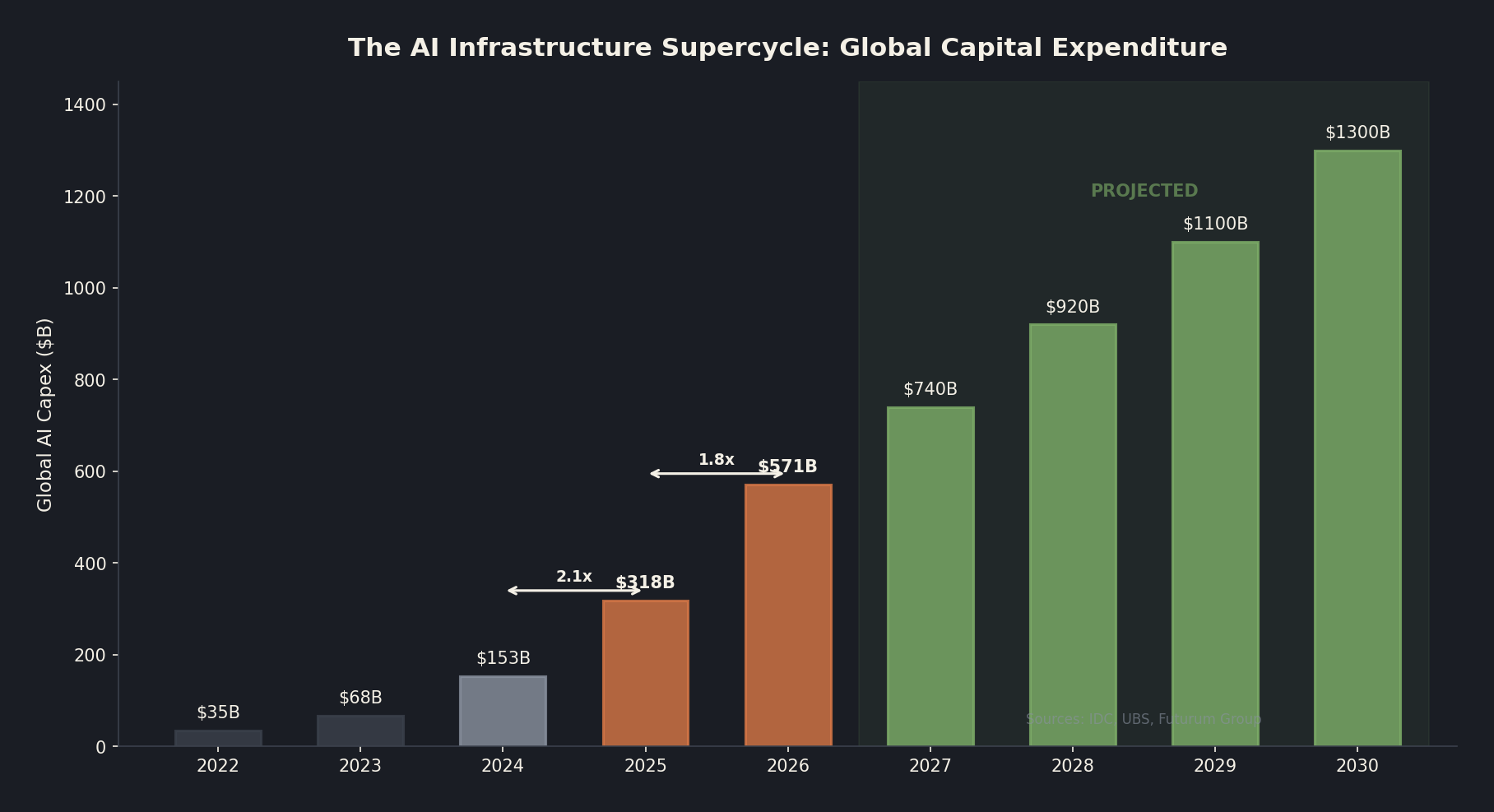
Full-year 2025 AI infrastructure spending totaled $318 billion, more than doubling the $153 billion recorded in 2024. The United States alone accounted for $69.2 billion in quarterly spending, representing 77% of global AI infrastructure investment.
For 2026, the five largest U.S. cloud and AI infrastructure providers have collectively committed between $660 billion and $690 billion in capital expenditure. Amazon leads with a projected $200 billion, followed by Alphabet at $175-185 billion, Meta at $115-135 billion, Microsoft tracking toward $120 billion or more, and Oracle targeting $50 billion. Approximately 75% of that, roughly $450 billion, is directly tied to AI infrastructure: GPUs, specialized chips, data centers, and supporting equipment.
UBS projects global AI capex reaching $1.3 trillion by 2030, growing at a 25% compound annual growth rate.
Those are not speculative numbers. That is committed capital. When companies collectively pledge nearly $700 billion to AI infrastructure in a single year, they are either building toward something transformational or creating the most expensive stranded asset in human history. There is no middle ground.
Altman's essay acknowledged this dynamic: "The economic value creation has started a flywheel of compounding infrastructure buildout to run these increasingly-powerful AI systems." He is right about the flywheel. Whether the flywheel leads to superintelligence or to a correction that makes the dot-com bust look quaint is the trillion-dollar question.
The Critical Voices That Deserve Airtime
The backlash to "The Gentle Singularity" was swift and substantive. It deserves serious consideration.
Lance Eliot, writing in Forbes, pointed out that the essay's "gentle" framing risks trivializing the disruption that workers and communities will experience. "Slow is not the same as easy," one critic observed. Altman acknowledges that "whole classes of jobs" will go away but assures us that "the world will be getting so much richer so quickly that we'll be able to seriously entertain new policy ideas we never could before." That is a promise without a mechanism. It is the same pattern we saw with globalization: aggregate gains were real, but the distribution of those gains was catastrophically uneven, and "new policy ideas" arrived decades too late for the communities that needed them.
AI ethicists have taken particular issue with the essay's tone. As one analysis noted, "the era of AGI and ASI seems to be portrayed as solely uplifting and joyous," with insufficient attention to concentration of power, surveillance risks, and the fact that "widely available" superintelligence does not mean equitably available. Altman writes that we should "focus on making superintelligence cheap, widely available, and not too concentrated with any person, company, or country." That aspiration sits awkwardly next to the reality that OpenAI is currently one of the most concentrated accumulations of AI capability on the planet.
On the technical claims, several researchers have pushed back on the assertion that "humanity is close to building digital superintelligence" as premature at best. Progress has been rapid in verifiable domains like coding and mathematics, but scientific discovery, creative reasoning, and robust real-world agency remain substantially harder problems. The gap between "can pass a benchmark" and "can reliably operate in the messy, ambiguous, politically charged environment of actual enterprises" is vast, and anyone who has tried to move an AI pilot into production knows this intimately. I explored this exact gap in The Production Gap: Why Enterprise AI Pilots Stall Before They Ship.
The alignment problem remains unsolved. Altman himself admits this, listing it as priority number one in his roadmap. But framing the singularity as already underway while acknowledging that the safety mechanism for that singularity does not yet exist is, to put it mildly, an aggressive sequencing choice. Altman's own comparison is telling: "social media feeds are an example of misaligned AI." We have had two decades to align social media algorithms with human wellbeing and have largely failed. The suggestion that we will solve alignment for systems orders of magnitude more powerful, while simultaneously deploying them at scale, requires extraordinary optimism.
What "Gentle" Actually Looks Like on the Ground
Here is where I want to shift from analyzing Altman's essay to connecting it to what I see every day in enterprise delivery.
Altman's most defensible point is also his most underappreciated one: "From a relativistic perspective, the singularity happens bit by bit, and the merge happens slowly. We are climbing the long arc of exponential technological progress; it always looks vertical looking forward and flat going backwards, but it's one smooth curve."
That matches lived experience. If you are leading a delivery program right now, the singularity does not feel like a singularity. It feels like a Tuesday. Your teams adopted Copilot or Cursor six months ago. PR volume went up. Review queues got longer. You started having conversations about AI governance that you were not having a year ago. You are probably wrestling with how to restructure your operating model to actually absorb AI capabilities rather than just bolting them on.
That is the gentle singularity in practice: not a dramatic rupture, but an accumulation of incremental changes that, viewed from a distance, amount to a transformation.
The enterprises that are navigating this well share a few characteristics. They have shifted from project-based to product-based funding for AI capabilities. They have built internal platforms that treat AI as infrastructure rather than a feature. They are measuring different things: not just velocity, but review throughput, rework rates, and the ratio of human time spent generating versus verifying. They are taking governance seriously before regulators force them to.
The enterprises that are struggling are the ones treating every new model release as a strategy inflection. They reorganize around each capability announcement, chase benchmarks instead of business outcomes, and confuse having AI tools with having an AI-native operating model.
The Enterprise Leader's Playbook for the Singularity (Gentle or Otherwise)
Whether you believe Altman's claim that we have crossed the event horizon or think it is premature marketing, the practical implications for enterprise leaders are surprisingly similar.
First, assume the capability curve continues upward. Even the most conservative expert predictions place AGI within 15 years. The capital commitments make it nearly impossible for the trajectory to reverse. Build your operating model for a world where AI capabilities compound, and you will be correct regardless of whether the singularity is gentle, abrupt, or still decades away.
Second, invest in the constraint that actually binds. Generation is cheap and getting cheaper. Verification, governance, integration, and organizational adaptation are expensive and getting more expensive. The bottleneck in your delivery program is not that AI cannot write code fast enough. It is that your humans cannot review, test, validate, and govern the output fast enough. That constraint is the one worth solving.
Third, treat alignment as a delivery problem, not a philosophy problem. When Altman writes about solving alignment at the civilizational level, that is interesting but abstract. When your agentic system makes a decision that costs a customer money or violates a compliance requirement, that is an alignment failure you need to address by Friday. Build evaluation frameworks that define "aligned" in measurable, testable terms for your specific context.
Fourth, plan for the labor transition now, not later. Altman's essay casually mentions that "whole classes of jobs" will go away. If you lead people, that is not a footnote. It is the hardest management challenge of the next decade. Reskilling programs, role redefinition, and honest conversations about which work survives and which does not: these are not things you can defer until the singularity arrives. They are things you need to be doing this quarter.
Fifth, stay skeptical of anyone selling certainty. The honest answer to "are we past the event horizon?" is that nobody knows. Not Altman, not Amodei, not Kurzweil, not the prediction markets. The range of expert opinion spans two decades. Anyone claiming precision in that range is selling something. Build for adaptability, not for a specific arrival date.
The Singularity Is a Delivery Problem
Altman closes his essay with a striking observation: "A subsistence farmer from a thousand years ago would look at what many of us do and say we have fake jobs, and think that we are just playing games to entertain ourselves since we have plenty of food and unimaginable luxuries."
He is right. And the lesson embedded in that observation is one that enterprise leaders should internalize: the singularity, if it comes, will not arrive as a single dramatic event. It will arrive as a series of delivery problems. Each one mundane in isolation. Each one part of a curve that, viewed from sufficient distance, looks like a phase transition.
Our job is not to predict when the curve goes vertical. Our job is to build organizations that can absorb the next increment of capability, and the one after that, and the one after that, without breaking. That is what "gentle" really means in practice. Not that the change is small, but that the pace is survivable if you are prepared.
Whether Altman is right that we have crossed the event horizon or premature by a decade, the preparation looks the same. The organizations that treat AI as a capability to be governed, integrated, and continuously adapted to will be the ones that thrive. The ones waiting for a definitive signal that the singularity has arrived will discover, as Altman suggests, that it happened while they were looking the other way.
The takeoff may have started. The question is whether your operating model can keep up.
References
- Altman, S. "The Gentle Singularity." June 10, 2025. blog.samaltman.com
- Amodei, D. "Machines of Loving Grace." October 2024. darioamodei.com
- Eliot, L. "Sam Altman Says AI Has Already Gone Past The Event Horizon But No Worries Since AGI And ASI Will Be A Gentle Singularity." Forbes, June 11, 2025. forbes.com
- "Sam Altman's AGI Shift: From Extinction Warning to Gentle Singularity." StartupHub.ai, June 13, 2026. startuphub.ai
- "AI Capex 2026: The $690B Infrastructure Sprint." Futurum Group. futurumgroup.com
- IDC. "AI Infrastructure Spending Caps Historic Year at ~$90 Billion in Q4 2025." idc.com
- "Shrinking AGI Timelines: A Review of Expert Forecasts." 80,000 Hours, March 2025. 80000hours.org
- OpenAI. "Introducing GPT-5." August 2025. openai.com
- "Altman's 'Gentle Singularity' Aims to Calm Fears, but Debate Persists." Pure AI, April 2026. pureai.com
- "What the Hell Happened with AGI Timelines in 2025?" 80,000 Hours. 80000hours.substack.com