
Staffing Agentic Delivery Teams: Why the Talent Pyramid Is Inverting
Agentic AI is automating the base of the engineering pyramid, the junior work that teams were built on. That does not shrink your team evenly, it inverts it, pushing demand toward senior reviewers and architects while entry level roles collapse. Here is how to staff for the inversion without starving your own pipeline.
Every leader I talk to has quietly run the same math. If an agent can do what a junior engineer does, the obvious move is to hire fewer juniors. Cheaper team, same output, healthier margin. It reads like common sense, and it is one of the most expensive mistakes you can make in 2026.
The error is not in believing agents can do junior work. They can, and increasingly they do. The error is in assuming that removing junior work removes a proportional slice of your team, leaving a smaller version of the same shape. That is not what happens. Agents do not shave the whole pyramid down evenly. They dissolve the base. And a pyramid without a base is not a smaller pyramid. It is an inverted one, with different economics, a different bottleneck, and a pipeline problem almost nobody is pricing in.
The pyramid you were trained to build
The classic engineering org is a pyramid for two reasons, and only one of them is cost.
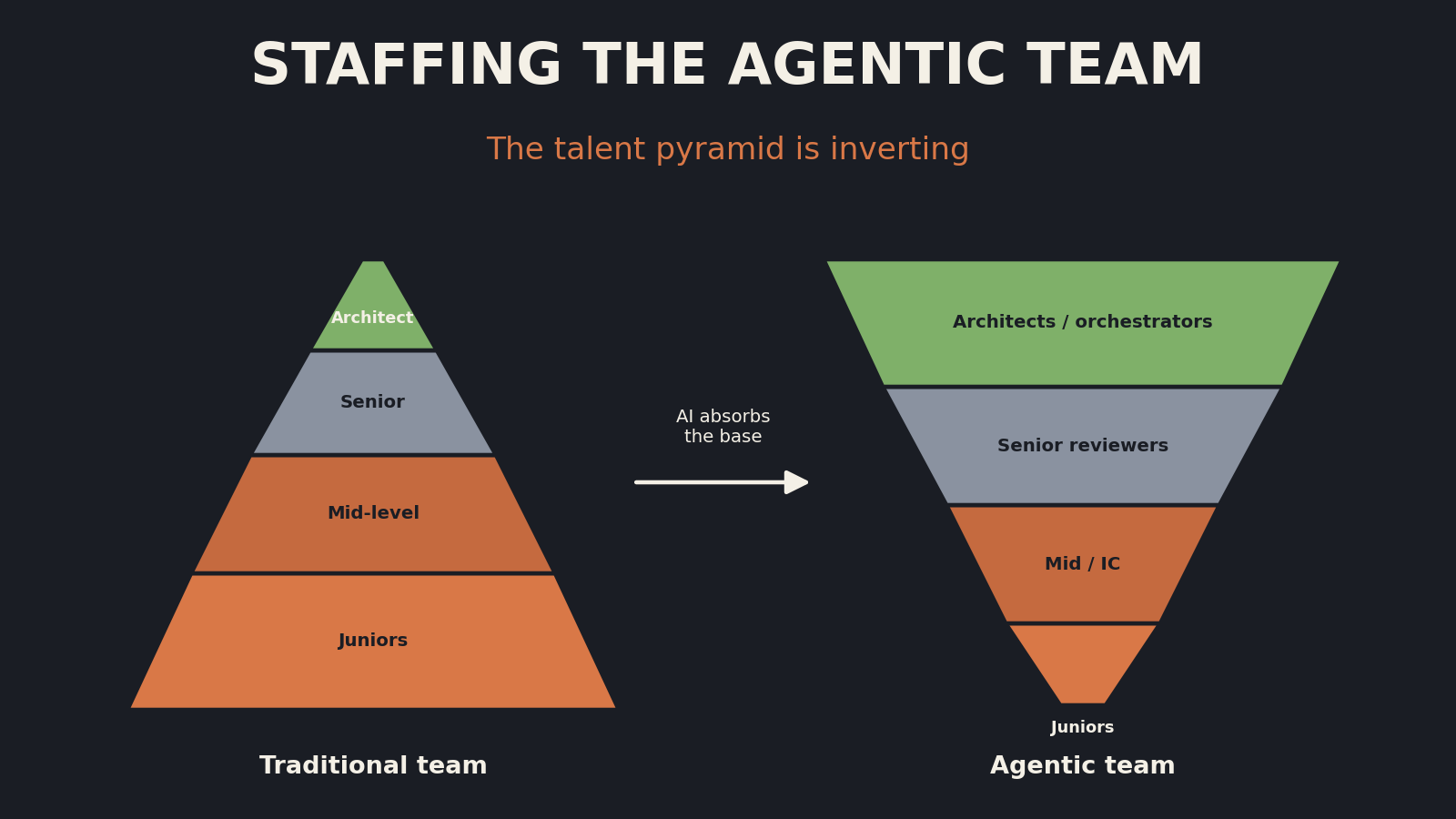
The visible reason is leverage. A few seniors set direction and make the hard calls, a wider band of mid level engineers carry the design, and the broad base of juniors supplies the volume of implementation. You paid apex salaries for apex judgment and got a lot of throughput underneath it at a lower blended rate. That is the version most budget conversations stop at.
The invisible reason matters more. The pyramid is a factory for making seniors. You cannot buy senior judgment on the open market fast enough to staff a growing org, so you grow it. Juniors write the boilerplate, break the build, sit through the code reviews, get paged at 2am, and slowly accumulate the scar tissue that turns into judgment. The base is not just cheap labor. It is the training substrate for everything above it. Remove it and you have not just cut costs, you have unplugged the machine that produces your future seniors.
Agents eat the base, not the middle
Here is what makes this moment different from previous waves of tooling. Automation is not landing uniformly across the skill ladder. It is concentrated, almost surgically, at the bottom.
Look at what agents are genuinely good at today and it maps with uncomfortable precision onto the junior job description: scaffolding and boilerplate, first draft implementations, unit tests, documentation, the glue code that wires one service to another. Google's 2025 State of AI-assisted Software Development report found AI adoption among developers has reached 90 percent, with a median of two hours a day spent working alongside these tools. The 2025 Stack Overflow Developer Survey put tool usage at 84 percent. This is not a pilot anymore. It is the substrate of daily work, and it is strongest exactly where entry level engineers used to earn their reps.
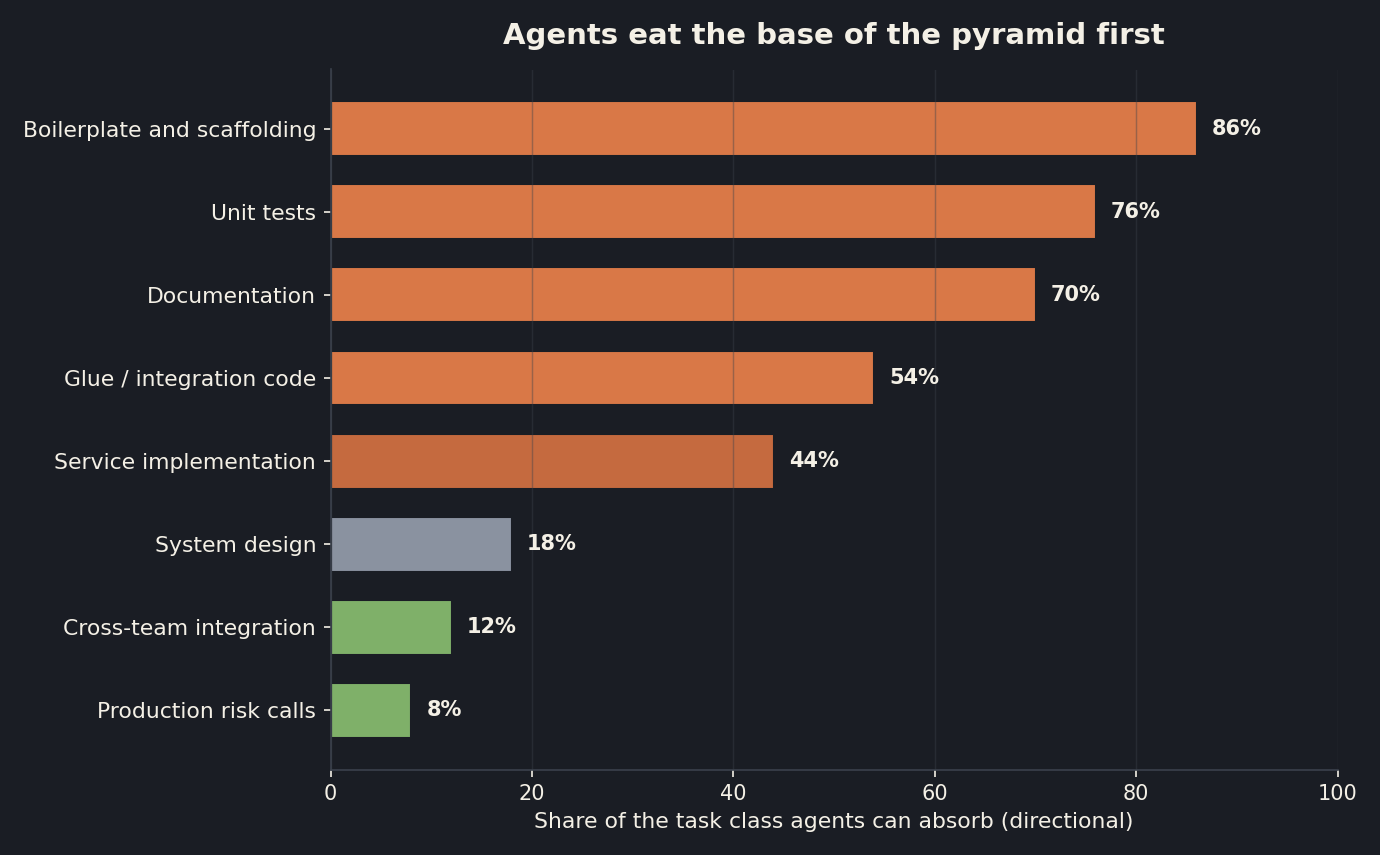
The higher up the ladder you go, the less agents help and the more they need supervising. System design, cross team integration, the judgment to say this change is too risky to ship on a Friday: these do not automate, and the presence of prolific agents actually raises the demand for them. So the automation curve and the seniority curve run in opposite directions. That is the whole story in one sentence, and it is why the shape has to change.
A smaller pyramid is not what you get
When you delete the base, the work that base was doing does not vanish. It changes character and moves up.
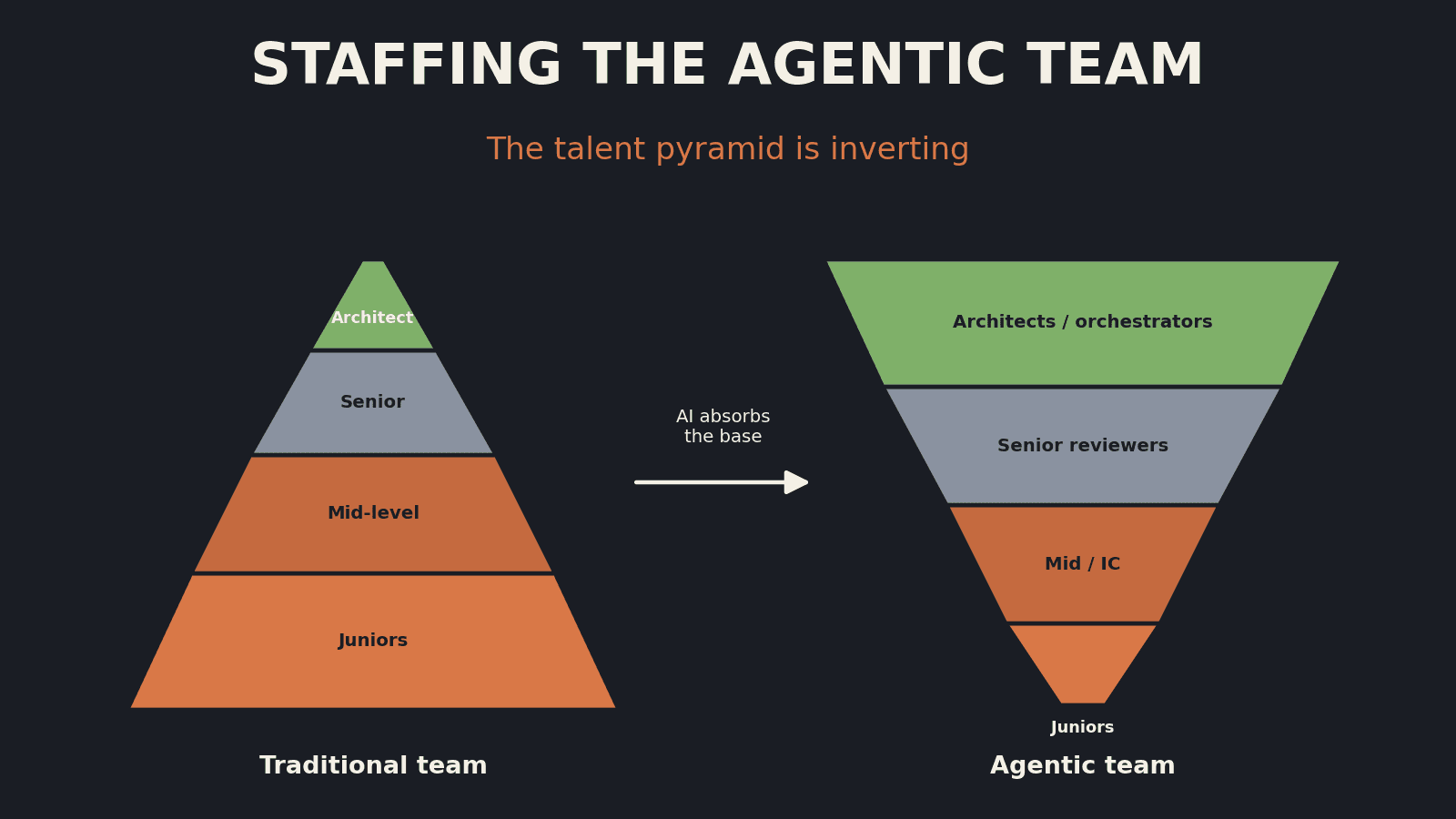
Somebody still has to decide what to build, and that was always senior work. But now somebody also has to review a flood of machine authored code, integrate it, and own it in production, and that is senior work too. The agent generates the draft; a human still has to stand behind it. So demand does not shrink proportionally with headcount. It shifts up the ladder. You end up with the inverted shape from the diagram above: few or no juniors at the point, a thick load bearing band of senior reviewers and architects at the top, each one orchestrating a fleet of agents instead of a team of people.
This is the staffing face of a change I described in The AI Operating Model Shift. The operating model moves from managing people who produce work to managing systems that produce work, and the humans left in the loop are disproportionately the experienced ones. The senior engineer stops being the rare apex of the pyramid and becomes its structural majority. That is a profound change in what a team is, and you cannot get there by simply not backfilling your juniors.
The constraint becomes judgment
Invert the pyramid and you invert the bottleneck along with it.
In the old shape, throughput was gated by how much code the base could produce. In the new shape, generation is nearly free and effectively unlimited. What is scarce is the senior attention required to verify, integrate, and make the risk calls on everything the agents produce. Your delivery ceiling is now measured in senior hours, not lines of code.
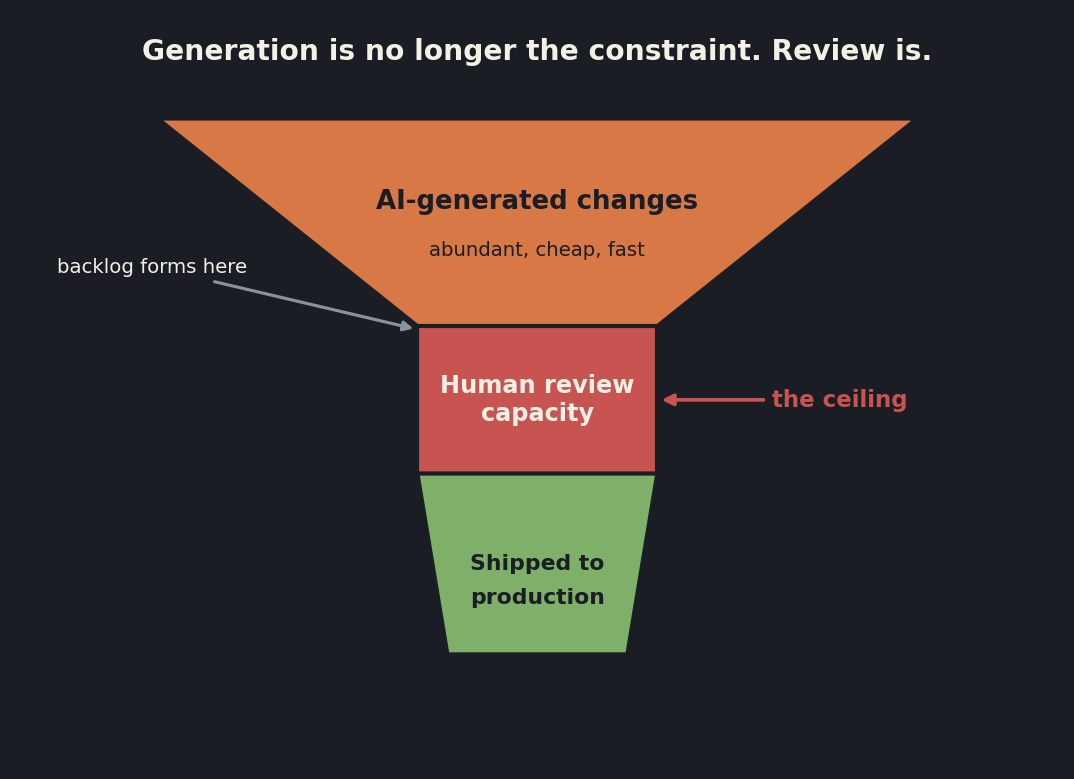
I made the operational version of this argument in Review Capacity Is the New Delivery Ceiling, and the staffing consequence is direct. If senior review and judgment are the constraint, then seniors are not a luxury you sprinkle on top of a team of juniors. They are the load bearing element, and the DORA research is blunt about what happens when the foundation underneath them is weak: AI amplifies whatever is already there. Strong teams get faster. Weak teams get faster at producing instability. The amplifier does not care which one you are, and a team staffed like it is still 2021 will find out the hard way.
The pipeline problem nobody is pricing in
Now the trap in the hire fewer juniors math becomes visible, and it is a slow moving one, which is exactly why it gets ignored.
The market is already tilting hard toward the top of the ladder. Entry level software engineering job postings fell roughly 67 percent between 2022 and 2024. Research from Stanford's Digital Economy Lab found that employment for developers aged 22 to 25 dropped nearly 20 percent from its late 2022 peak, even as employment for older, more experienced engineers held steady or grew. Senior developer unemployment, meanwhile, sits near 1 percent. Demand has not fallen. It has migrated.
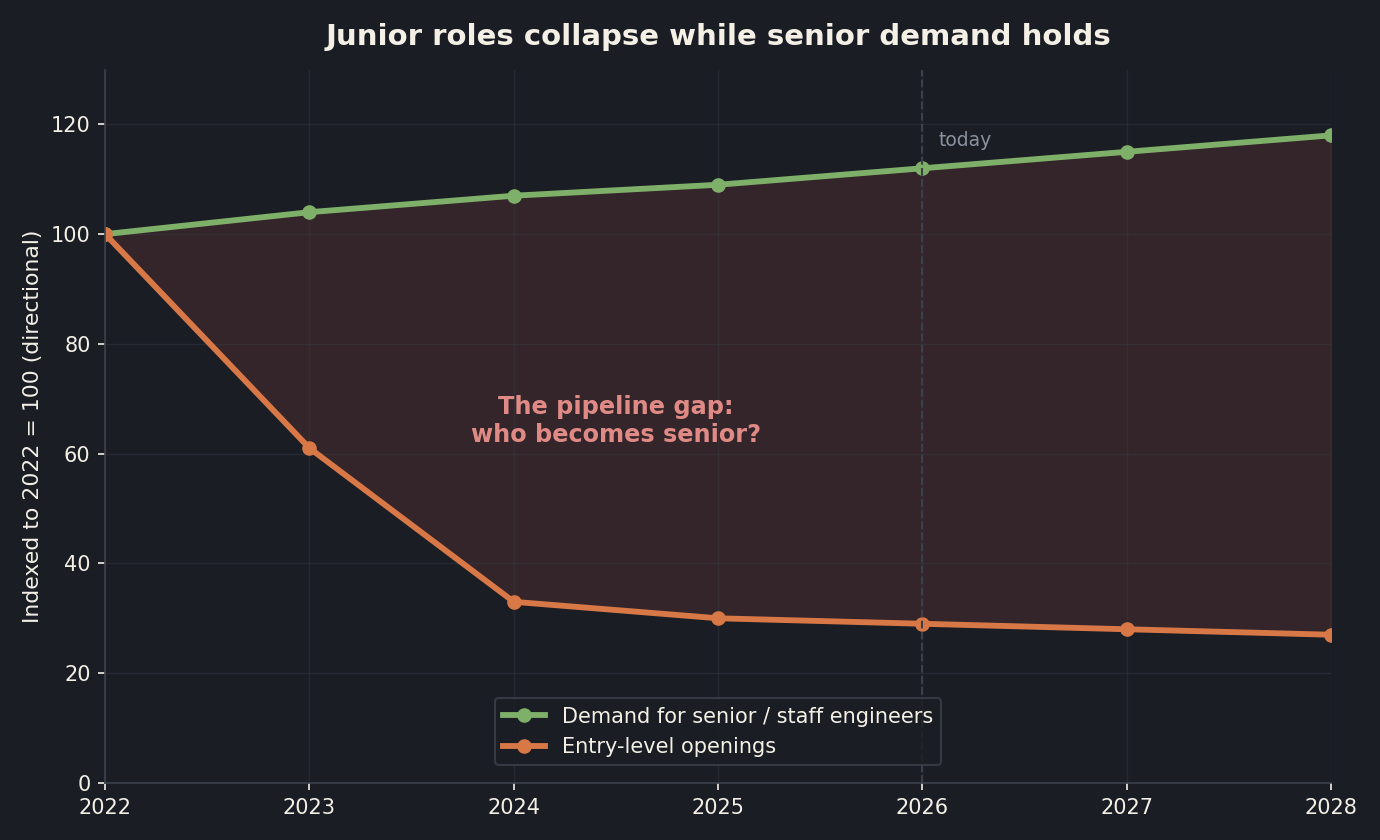
Read those two curves together and the problem states itself. Seniors are not manufactured, they are grown, and the growth medium is the junior base that the entire industry is busy deleting. If every company optimizes the same way at the same time, hiring fewer juniors because agents cover the entry level work today, then in five to seven years the senior talent that the inverted org depends on will not exist in the numbers anyone needs. We are collectively optimizing this quarter's margin by consuming the supply that next cycle runs on.
This is the quiet case behind a point I made in AI Can Never Replace Quality Individuals. The value was never the typing. It was the judgment, and judgment is a cultivated asset with a long lead time. You can stop planting and enjoy the savings for several years before the forest thins. The bill still comes.
How to staff for the inversion
None of this means the inverted pyramid is wrong. It means you have to staff it deliberately instead of backing into it. Five moves matter.
Re-scope the junior role, do not eliminate it. The entry level job changes from producing code to directing, reviewing, and verifying agent output far earlier in a career than before. The apprenticeship compresses, it does not disappear. Hire for judgment in training, not for typing speed, and give new engineers real ownership of agent supervised work instead of pretending the rung no longer exists.
Treat senior review time as your actual capacity budget. If seniors are the constraint, protect their hours like the scarce resource they now are. That means explicit limits on review work in progress, fewer low value meetings on senior calendars, and tooling that makes agent output cheaper to verify. Every hour of senior attention you waste is a direct hit to throughput, not a soft cost.
Compress the path to senior on purpose. The reps that used to make seniors, the boilerplate and the grind, are the exact reps agents removed. So you have to manufacture the replacement reps deliberately: put newer engineers on system design, code critique, incident ownership, and cross team work years earlier than tradition allowed. Growing a senior in four years instead of eight is now a competitive capability, not a nicety.
Stop measuring the things agents made meaningless. Commit counts and pull request volume were always weak signals, and agents have made them actively misleading, since both are now nearly free to generate. Measure verified value shipped and reviewer utilization instead. The DORA program has been making a version of this argument for years, and the agentic era makes it non negotiable.
Own the pipeline as a strategic risk. Put who becomes senior in 2031 on the same planning surface as your cloud spend and your hiring plan. Internal apprenticeship, structured rotation, and deliberate exposure are no longer HR programs. They are supply chain management for the one input your operating model cannot function without.
The leadership read
A senior heavy team orchestrating fleets of agents can be extraordinarily productive. The inverted pyramid is not a failure state. The failure state is treating the inversion as a simple headcount cut, reading the org chart top down, and quietly not backfilling the bottom because the numbers look good this quarter.
You are not buying a smaller version of the team you had. You are buying a different machine, with a different constraint, senior judgment, and a different fragility, a talent pipeline you can starve for years without noticing. The leaders who win the next cycle will be the ones who staffed for the shape they were actually building, not the one they were busy removing.
References
- Google DORA. State of AI-assisted Software Development 2025. dora.dev
- Stack Overflow. 2025 Developer Survey. survey.stackoverflow.co
- Stanford Digital Economy Lab. Research on AI and early career employment. digitaleconomy.stanford.edu