
PI Planning Is Running on the Wrong Clock: Rethinking SAFe Cadence for Agentic Delivery
SAFe PI planning assumes a ten-week plan can survive contact with delivery. Agent-augmented teams now learn faster than the plan can absorb. Here is why PI commitments decay by mid-increment, and the three-clock planning model that keeps alignment without freezing scope.
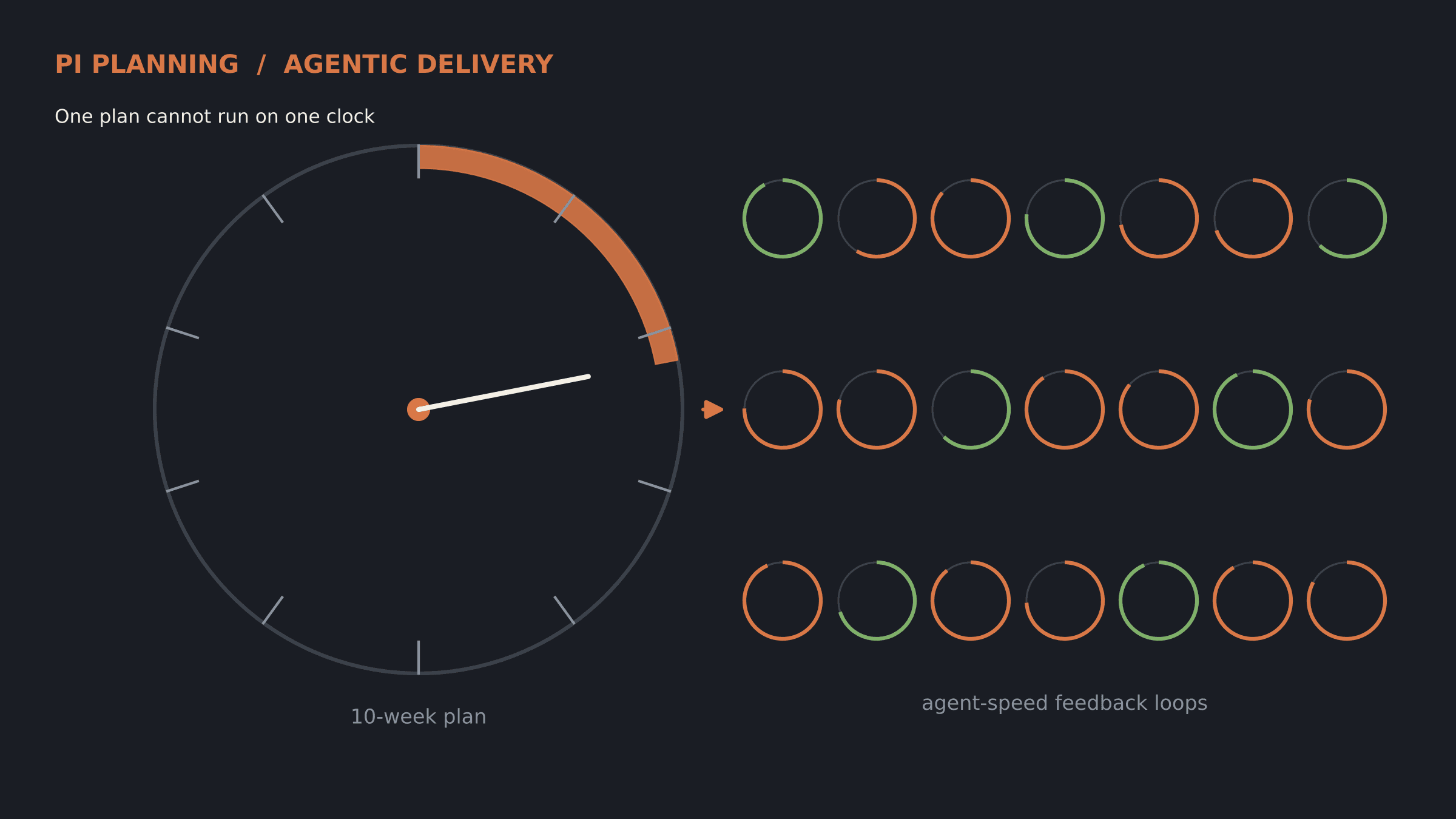
PI planning is the most expensive meeting in enterprise agile, and in a growing number of release trains it is now producing a plan with a shelf life shorter than the increment it covers. Two days, a hundred or more people, a program board covered in red string, and a confidence vote of four fingers. Then, by week five, half the objectives no longer describe the work anyone is doing. The problem is not that teams are bad at planning. It is that the plan is running on a ten-week clock while the work now runs on a daily one.
I have sat in a lot of PI planning rooms. I have defended the event to skeptics and I have criticized it to its fans. My view has not changed on the core value: getting every team on a train into one room to see the dependencies and argue about sequencing is one of the best things SAFe ever did. What has changed is the speed of the underlying system. When agents write a meaningful share of the code, draft the tests, and prototype three options before lunch, a fixed ten-week commitment stops being a plan and starts being a historical document.
If you run an Agile Release Train, coach one, or fund one, this is the conversation to have before your next PI.
The PI was designed for a slower feedback loop
According to the Scaled Agile Framework guidance on the Program Increment, a PI is a timebox typically eight to twelve weeks long, usually four development iterations followed by an Innovation and Planning iteration. That length was not arbitrary. It was sized to the speed at which a large organization could build something meaningful, learn from it, and adjust funding and priorities without thrashing.
That sizing made sense when the dominant constraint was build time. A feature took weeks to implement, so a quarter-scale plan matched the grain of the work. You learned roughly once per iteration, and four or five learning events per PI was enough to steer.
Agentic delivery moved the constraint. Build time for a large class of work has collapsed. Prototypes that took a sprint now take an afternoon. A team can try two architectural approaches in parallel and throw one away. The learning rate went up by an order of magnitude, but the commitment cadence stayed exactly where it was. That mismatch is where PI plans go to die.
Plan half-life: why commitments decay faster now
Here is the shape I see in agent-augmented release trains. It is illustrative, not a benchmark, but every program leader I have shown it to has recognized their own train in it.
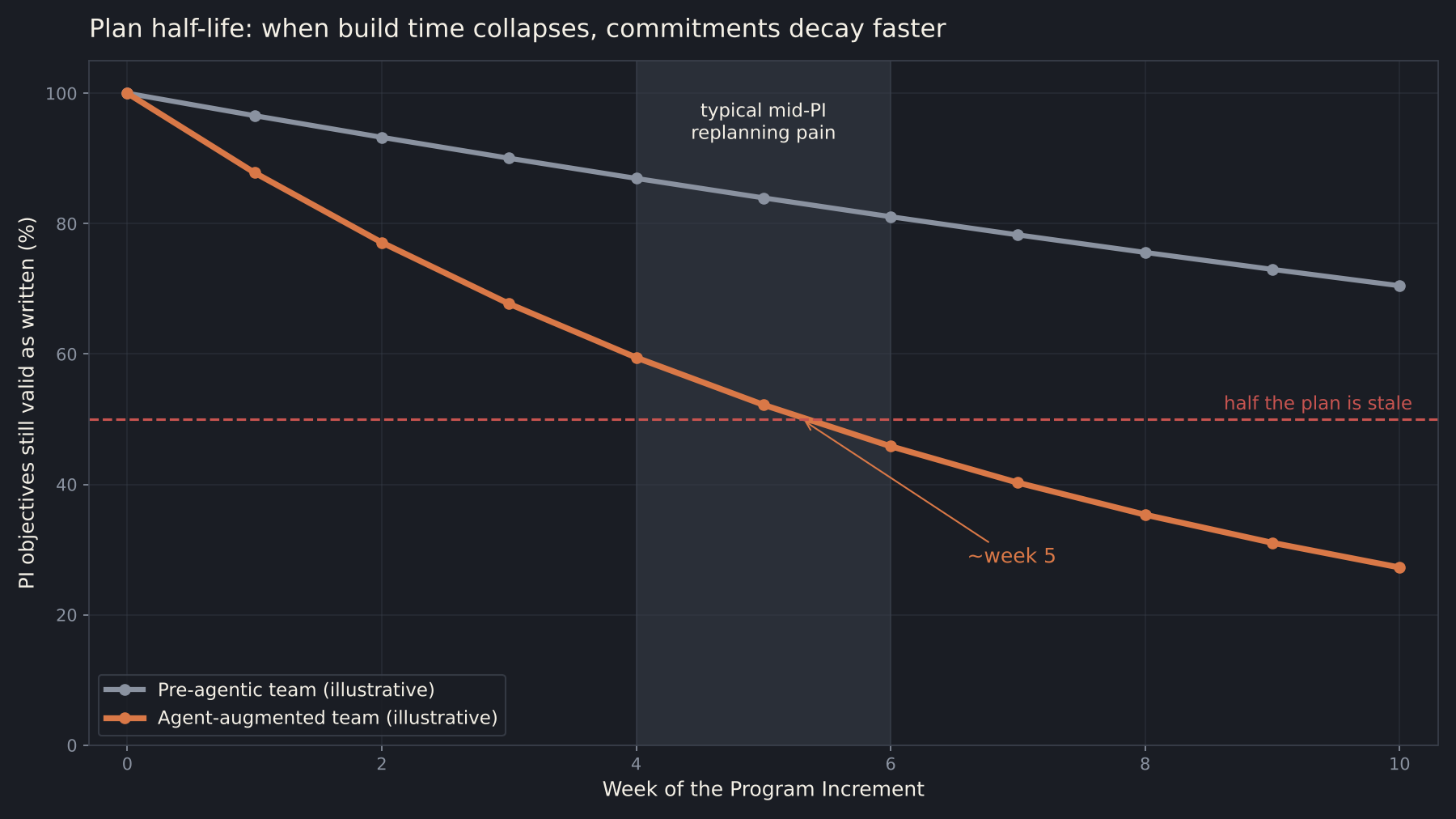
The pre-agentic line decays slowly. Some objectives slip, some get reprioritized, but most of the plan still describes reality at the end. The agent-augmented line decays fast, and it is not because the team is failing. It is because the team is learning. Faster discovery means faster invalidation. You find out by week two that the integration you planned for week six is unnecessary, or that the feature you sized at three iterations shipped in four days and exposed a harder problem nobody planned for.
Faster output did not mean a more predictable plan
There is a tempting assumption that if teams go faster, plans get easier to hit. The data says otherwise. Google's 2024 DORA report on AI in software delivery found that a 25 percent increase in AI adoption was associated with an estimated 1.5 percent decrease in delivery throughput and a 7.2 percent decrease in delivery stability. Individual productivity went up, and system-level delivery did not follow automatically.
That gap is exactly what a PI plan cannot see. The plan measures commitment against features. The real constraint has moved to review capacity, integration, and stability, which is the argument I made in review capacity is the new delivery ceiling. When the bottleneck moves and the plan does not, the plan becomes a precise description of the wrong thing.
Variance, not velocity, breaks the iteration loading
PI planning asks every team to load iterations one through four with stories and check them against capacity. That exercise assumes a stable mean: a team that did 40 points last iteration will probably do about 40 next time. Agentic work does not behave like that. Some items finish in hours, and some hit an agent dead end and take three times as long as expected. As I covered in capacity forecasting in agentic delivery, the distribution has a fat right tail, and loading iterations against an average is a precise way to be wrong.
The answer is not to abandon PI planning
The reflexive response is to declare the PI dead and move every team to continuous flow with no shared planning event. I think that is a mistake, and I say that as someone who has argued that SAFe often brings more overhead than it needs.
Large organizations still have real coordination problems that agents do not solve. Shared platforms, regulated releases, interface contracts between teams, budget cycles, and vendor commitments all still exist. Agents compress build time. They do not compress organizational latency. A security review still takes the time it takes. A downstream team still needs to know when your API contract changes. A finance partner still funds on a quarterly rhythm.
So the goal is not to delete the event. It is to stop asking one clock to do three jobs.
The three-clock planning model
The fix I have been using with release trains separates planning into three cadences, each tuned to the speed of the decisions it governs.
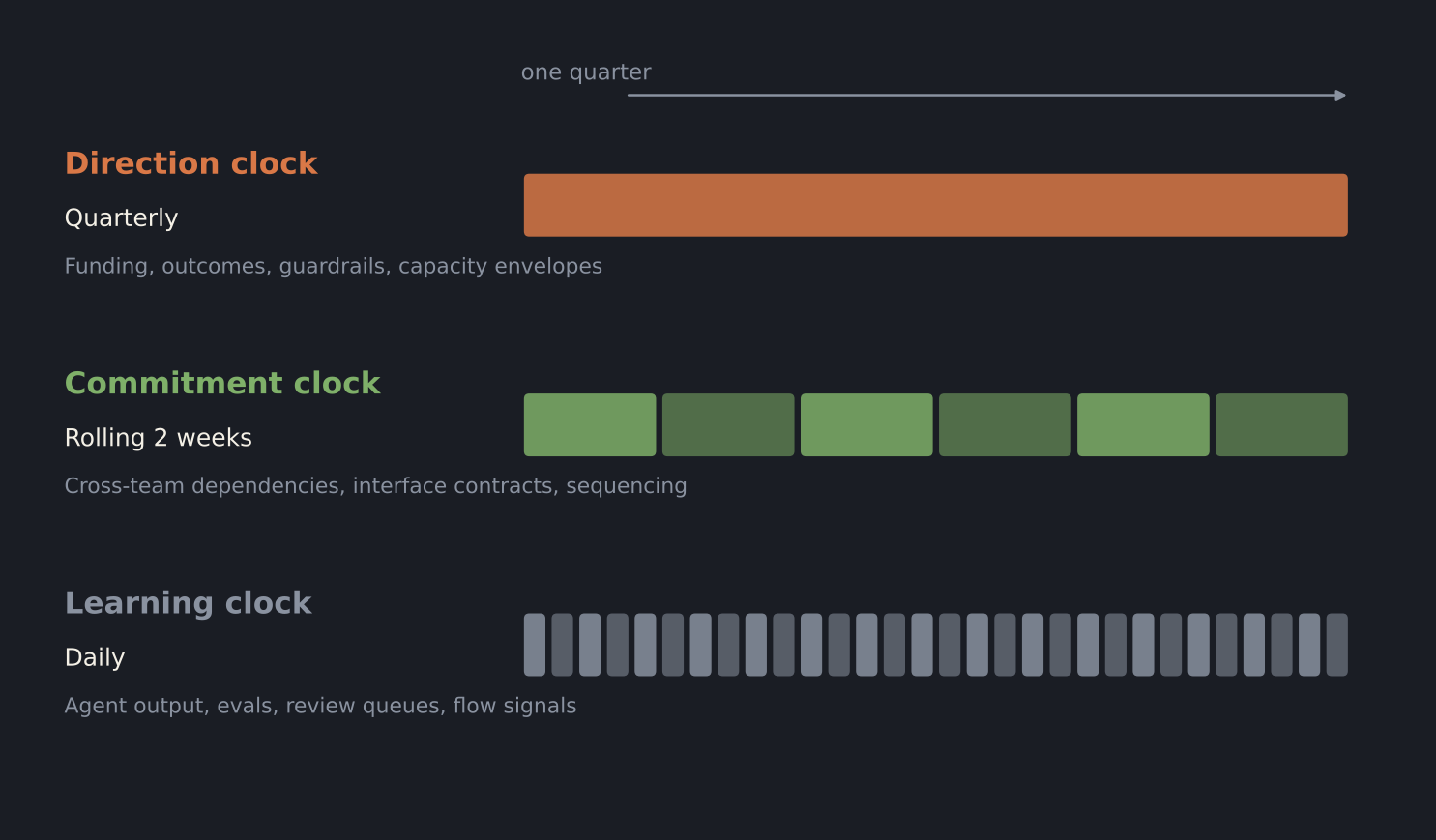
The direction clock: quarterly
This is what PI planning should protect. Business context, outcome objectives, funding guardrails, and capacity envelopes for each team. The output is not a list of features per iteration. It is a short set of outcomes with measurable signals, plus explicit constraints: which platforms are in scope, which interfaces are frozen, what the risk appetite is, and how much capacity each team is expected to spend on new work versus run work.
Commit to outcomes and boundaries at this cadence, not to scope. Outcomes survive learning. Feature lists do not.
The commitment clock: rolling two weeks
This is where cross-team dependencies live. Every two weeks, a short sync across the train confirms the next four weeks of interface commitments: which contracts are changing, which teams need something from which, and which sequencing decisions are now locked. Think of it as a rolling-wave program board that only ever covers the near horizon in detail.
This is the part of PI planning that delivered the most value, and moving it to a rolling cadence makes it more useful, not less. Dependencies are where delivery risk concentrates, a point I made in dependency density and modern risk modeling. A dependency agreed ten weeks ago is a guess. One agreed last Tuesday is a commitment.
The learning clock: daily
This is the clock the agents run on, and it should feed the other two, not compete with them. Agent output, eval results, review queue depth, cycle time percentiles, and stability signals flow continuously. The program does not replan daily. It watches daily, so that when the commitment clock turns over, the decisions are grounded in what actually happened.
The discipline here is to keep learning-clock signals out of the direction clock unless they cross a defined threshold. If every daily insight can reopen quarterly outcomes, you have traded a frozen plan for a thrashing one.
Re-scoping the PI planning event itself
With three clocks in place, the two-day PI event changes shape. Some of it becomes more important, some of it shrinks, and some of it should stop.
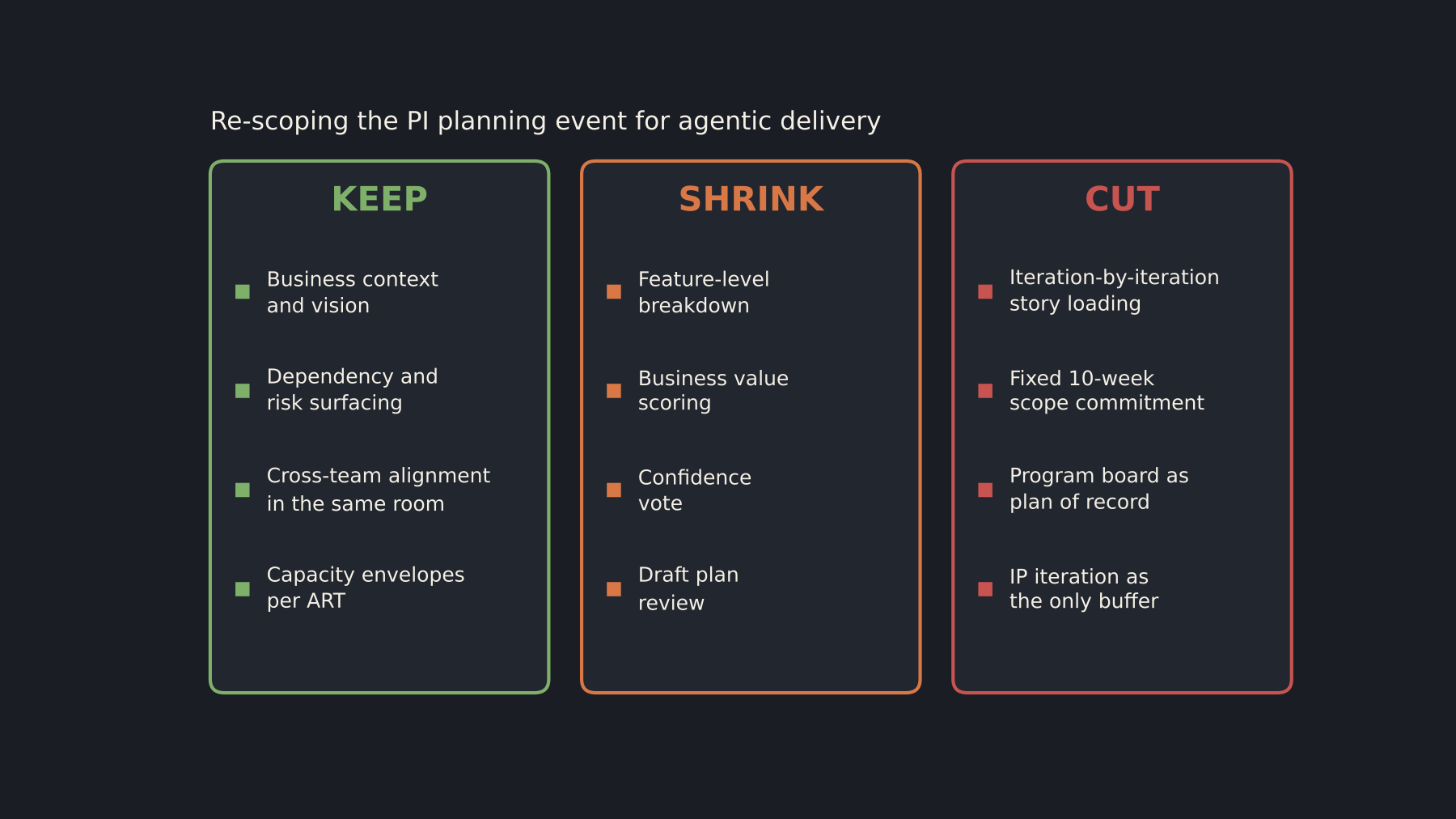
Keep the parts that create shared context. Leadership presenting the business situation, architecture surfacing the constraints, and teams negotiating dependencies face to face are worth the airfare. Capacity envelopes per train are also worth keeping, because they force a real conversation about how much new work the organization can absorb.
Shrink the parts that pretend to precision. Feature breakdown should stop at the level needed to see dependencies, not decompose into stories. Business value scoring should be quick and relative. The confidence vote is still a useful signal, but it should be a vote on the outcomes and the first four weeks, not the full ten.
Cut the parts that encode the old clock. Loading iterations three and four with stories is fiction in an agentic train. Treating the program board as the plan of record for ten weeks creates a document that is out of date before the room empties. And relying on the IP iteration as the only buffer assumes variance arrives politely at the end of the increment. It does not. Buffer belongs in every commitment window.
What this means for program leaders
If you are a Release Train Engineer, a technical program manager, or the person who funds the train, a few practical shifts follow.
- Change what you report. Stop reporting percentage of PI objectives met as the headline metric. Report outcome movement, dependency commitments honored on the rolling clock, and flow stability. Percentage of plan met rewards teams for ignoring what they learned.
- Make the commitment clock lightweight. Thirty to sixty minutes every two weeks across team leads is enough. The artifact is a short list of interface commitments with owners and dates, not a rebuilt program board.
- Set thresholds for escalation. Define in advance which learning-clock signals can reopen a direction-clock decision. Without that rule, every surprise becomes a leadership debate.
- Plan review and integration capacity explicitly. If agents doubled code throughput, your reviewers, testers, and release managers did not double. Put their capacity in the envelope or the plan will quietly assume it is infinite.
- Keep the room. The face-to-face alignment is the part of PI planning that agents make more valuable, not less. When code is cheap, shared understanding is the scarce resource.
The plan is a tool, not a promise
The most damaging thing a PI plan can become is a promise that teams feel obligated to keep after the evidence has moved on. SAFe was built to bring alignment to large organizations, and that goal is more important than ever when agents let every team move faster in more directions at once. But alignment does not require freezing ten weeks of scope. It requires agreeing on where you are going, being precise about the next few weeks of dependencies, and listening hard to what the work is telling you every day.
Run the plan on the right clocks, and PI planning goes back to doing what it was always best at: getting the right people in a room to make the hard tradeoffs together.
References
- Scaled Agile, Inc. Program Increment. scaledagileframework.com
- Scaled Agile, Inc. PI Planning. scaledagileframework.com
- Google Cloud DORA. Announcing the 2024 DORA report. cloud.google.com
- Rick Pollick. Capacity Forecasting in Agentic Delivery. rickpollick.com
- Rick Pollick. Review Capacity Is the New Delivery Ceiling. rickpollick.com